Italo Calvino en Esperanto (4)
“Fantasto, realo kaj medito”: recenzo de La kosmokomikoj kaj Palomar de Italo Calvino kun biografiaj informoj, de Carlo Minnaja, en La Ondo de Esperanto, 2024, №1 (319).

“Fantasto, realo kaj medito”: recenzo de La kosmokomikoj kaj Palomar de Italo Calvino kun biografiaj informoj, de Carlo Minnaja, en La Ondo de Esperanto, 2024, №1 (319).

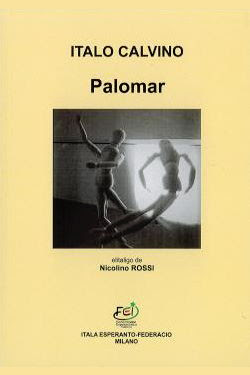
Palomar (1983), romano de Italo Calvino esperantigita de Nicolino Rossi, eldoniĝis de Itala Esperanto-Federacio (Milano, 2023, 96 paĝoj). La unuaj dek paĝoj estas libere elŝuteblaj.
Troveblas la "Enkonduko de la aŭtoro" kaj komenco de: 1. La ferioj de Palomar: 1.1. Palomar sur la plaĝo: 1.1.1. Legadi ondon.
La kosmokomikoj (1965) konsistas el 12 "pra-universaj sciencfikciaj rakontoj" de Italo Calvino, estas esperantigita de Nicolino Rossi kaj eldonita de Itala Esperanto-Federacio (Milano, 2023, 108 paĝoj). La unuaj dek paĝoj estas libere elŝuteblaj.
Troveblas la "Antaŭparola prezentado" kaj la komenco de la rakonto "La distanco de la Luno".

Mi dum jardekoj familiaras pri la verkaro de Jorge Luis Borges, sed itala verkisto inspirita de Borges estas nova sperto por mi. Temas pri Italo Calvino (1923-1985). Malfacilas priskribi la strukturon de liaj fikciaĵoj; multajn oni nomus postmodernismaj aŭ metafikciaj.
Nu, mi kaptis la okazon por libroklubo legi la romanon Se una notte d'inverno un viaggiatoren (1979) en anglalingva traduko, If on a winter's night a traveler (1981) [= Se en vintra nokto vojaĝanto]. Ĝi estas unika, genia verko, ankaŭ malsimila kompare al la strukturoj de rakontoj de Borges. La ĉefrolulo estas Vi, la leganto, kaj la ĉefa temo estas la karaktero de legado; aldone, la eskapema rilato de la aŭtoro kun la teksto kun la eldonejoj kaj reproduktado de libroj kun Vi kaj aliaj legantoj kiel interpretantoj. Sed ĉi tio ne estas teda, gurdita avangardaĵo. Kiel leg-aventuro ĝi legiĝas kiel detektivromano.
La romano komenciĝas. Vi tenas en la manoj ĵus eldonitan romanon de Italo Calvino kun titolo Se en vintra nokto vojaĝanto. Vi legas detale kiel vi tenas la libron kaj poziciigas vin prepare al komenco legi. Vi konstatas, ke via ekzemplero estas fuŝaĵo: nur komenca parto de la teksto de Calvino estas ene; iel miksiĝis en via ekzemplero komenco de alia romano de alia, fremdlanda aŭtoro, kaj pri la originala lingvo vi malcertas; eble ĝi estas pola: Ekster la urbo Malbork de Tazio Bazakbal. Do vi revizitas la librovendejon kun via fuŝita ekzemplero, kaj tie vi renkontas Legantinon, Ludmilla, kiu spertas la saman problemon. Vi gajnas ŝian telefonnumeron. Ŝi estas voranto de romanoj, unu post alia. Kiam vi telefonas, vi atingas ne ŝin, sed ŝian fratinon Lotaria, kiu estas profesoro pri literaturo kiun interesas klasifikado kaj teoriumado sed ne verkojn mem, tute male ol ŝia fratino.
Nu, la ĉaso daŭras. Vi la leganto serĉas kompletajn tekstojn de romanfragmento post fragmento kiujn vi trovas en via serĉado tra dek diversaj romanoj de diversaj ĝenroj de diversaj aŭtoroj en diversaj landoj tradukitaj eble fraŭde de nefidinda tradukisto. Sed ĉiupaŝe via serĉado frustriĝas. Vi serĉas Ludmilla ankaŭ pro amora intereso. Kaj fine .....
La necerteco de rilatoj inter verkoj kaj diversaj kaj diverstipaj roluloj pri verkado, tradukado, eldonado, disdonado, cenzurado, interpretado pensigas ankaŭ pri la komprenrilatoj inter homoj. La komplekseco kaj lerteco de la konstruo de ĉi tiu romano superas ajnan ne-beletran postmodernisman teorian traktaĵon.
Nu, poste mi faris pluan esploron anglalingve, do .....
Italo Calvino: A Select Bibliography
Do kio en Esperanto? Bonŝance estas afiŝo de Antonio De Salvo je 19 Septembro 2017 ĉe blogo Esperanto-vivo:
Italo Calvino
Troveblas tie informoj pri tradukoj de Calvino en Esperanto, ankaŭ la rakonto Apologo sull’onestà nel paese dei corrotti = Apologo pri honesteco en la lando de koruptitoj en la itala kaj en Esperanto.
Pri:
Vilmos Benczik, "La esperanta literaturo tra la lupeo de
kelkaj lingvoteorioj kaj literaturkonceptoj," ESPERANTOLOGIO / ESPERANTO STUDIES, EES Kajero 5, 2011 / Issue No. 5, p. 37-59.
Dum la sovetia epoko Vilmos Benczik estis motoro de multa esperantista literatura aktivado, kaj interpretis aferojn laŭ marksisma modelo. Sed plurajn jarojn post la fino de tiu epoko, li
verŝajne tute forgesis marksismon kaj estas kaptita de la idearo de
Jacques Derrida. Li eĉ pensas ke ties lingvoteorio (kiu, notu, havas
nenian lingvosciencan subtenon) instigas pli favoran teorian sintenon al Esperanto kaj ties literaturo. Mi deprimiĝas legante ĉi tiujn absurdaĵojn.
I have no investment in steampunk as a lifestyle/subculture
or as a literary/artistic genre, but I do think it is a significant phenomenon
and symptomatic of our time. It is the futurism of the past, and that it should
surface as a recognizable phenomenon and be named in the present is probably
not accidental. (Of course there were manifestations of steampunk long before
it became a category, but I’m referring to its emergence as a conscious
movement.) Why now the futurism of the past?
The
fantasy future of unlimited possibilities coexists, even as it did a century
ago, with the fantasy of a terminal disaster much closer to realization. The
contours of futurism have already been mapped out. Not only do we live in an alleged postmodern age, but we live in
a combinatorial age, and a retrospective age. Our society has already reached
the peak of real abstraction. We look backwards toward origins, reevaluating
the past, the present, and the path taken in between.
Steampunk matters, I think, because the tangible origins of
science fiction, of futurism, and of what has been constructed throughout the
twentieth century, is really the nineteenth century. Science and technology as
well as the projective imagination reached a critical point in that century,
and so, rather than with foraging, pastoral, agricultural, feudal, mercantile,
or emergent industrial society, the future originates in the nineteenth
century.
Steampunk, with its odd mixture of futurism and the quaint
and outdated Victorian aesthetic, combines and naturally merges with the parallel
genre of alternate history, which itself could be considered the fantasy
counterpart of the historical novel, which has also taken on a new flavor in
recent decades. And this retrospective consciousness is also a reflexive
consciousness. We are already aware of fundamentally changed assumptions in contrast
to those of the 1940s, ‘50s, ‘60s, and ‘70s, so when we look back more than a
century, we are not just trying to recreate a bygone era but to be aware of its
presuppositions, and from there postulate alternate histories.
(This retrospective consciousness enters into historical
Jewish fiction as well, which is where Esperanto now shows up as one of those
utopian possibilities of a long-lost era. But Esperanto and Volapük show up
outside of Jewish preoccupations as well.)
Of course, any subculture can end up as yet another thoughtless,
escapist refuge. There is no novelty left in subcultures, though of course
creativity can be found anywhere. Still, this awareness of the ability to
manipulate cultural codes has many twists. And so there is not only steampunk,
but there is black steampunk, as there is already Afrofuturism, another conceptual
category constructed many decades after its manifestations appeared in
practice.
Which brings me to black steampunk. Maybe, in the spirit of
retro, it should be called Negro steampunk.
In any case, here are some manifestations of said orientation.
Beyond
Victoriana
State of Black
Sci-Fi 2012: Why I love Steampunk!
Balogun, 23 Jan
2012
The State of Black SF 2012: Why I love Steampunk
Valjeanne’s Blog, January 24, 2012
Guest Post: Steampunk/Alt History Week
Living in Color
by Tanita Davis
SFWA Blog, December 23, 2010
The Intersection of Race and Steampunk: Colonialism’s
After-Effects & Other Stories, from a Steampunk of Colour’s Perspective
By jha
Racialicious (blog), June 24,
2009
Do Goggles Block the Sun? Steampunk in Africa
Clay and Susan Griffith
Tor.com, Oct. 28, 2010
Steampunk Webcomic
Set in Africa
By Manny, Steampunk Costume, June 11, 2010
Africa: "Steampunk Values." Bushpunk Slums
Bombasticelement.org, November 22,
2010
African Empires
By G. D. Falksen
Steampunk Fashion, June 30, 2009
Steampunk
Author Balogun Oyabode Abeegunde Writes Harriet Tubman as an Extraordinary
Gentlewoman!
Alicia McCalla, December 5, 2011
Interview with the African American Steampunk Author of
"Moses: The Chronicles of Harriet Tubman"
Yahoo group discussion, Dec. 6, 2011
Steampunk:
What it is, why I came to like it, and why I think it’ll stick around
The Clockwork
Century, August 8, 2009
Books: Yet Another
Ramble About Steampunk Romance
The Fancy Reader, Dec. 12, 2011
African steampunk merchandise
Etsy
Esperantistoj, iam mi tradukos miajn cerbumaĵojn pri vaporpunko al Esperanto. La temo rilatas al Esperanto pro la apero de Esperanto en historiaj kaj ukroniaj fikciaĵoj, kaj pro la fakto ke Esperanto estas samtempa kun la vaporpunka erao. Legu miajn antaŭan afiŝojn pri vaporpunko kaj ukronio.


Here is a sampling of recent projects in the visual arts, literary creation, literary and cultural theory incorporating ideas from the legacy of the ars combinatoria.
Jen kolekteto de lastatempaj projektoj de arto, literaturo, kaj kulturteorio (per legaĵoj anglalingvaj) kiuj utiligas la intelektan heredaĵon de ars combinatoria.
Orderly disorder: post-human creativity
Dr. Rolf Hughes
On the 'death of the author', 'metacreation', emergence, creativity, complexity. Opposes the Romantic, creative individual to the ars combinatoria of these post-humanist conceptions.
Spring Cleaning: from Bad to Rotten Words Project
Lulú De Panbehchi
Ars Combinatoria Project, Dr. Artur Matuck
May 5th, 2009
Combining Llull, Oulipo, Lyotard, et al in the Internet environment.
On the Dissolution Through Sameness in Emptiness In: Decodierung:Recodierung, Triton Verlag Wien, 2000.
Toni Kleinlercher
On literary forms inspired by Llull, Leibniz, etc.
Between a Creative Scotland and a Cultural Scotland: Pat Kane chapter for 'Radical Scotland: Arguments for Self-Determination
Thoughtland (blog), 11 March 2011
On the question of "creative industries" in Scottish cultural policy. The ideas of Paulo Virno are referenced, apparently pertaining to the vacillation between indeterminate, chaotic nature of human experience and the retreat to stereotypical formulae, i.e. "reaction-halting behaviours, obsessive tics, the drastic impoverishments of the ars combinatoria".
Ars Combinatoria at Transmediale
Jonathan Gray, 7 February, 2011
Ars Combinatoria (Transmediale)
Inspired by Leibniz, "The Ars Combinatoria project is about creating new works with public domain or openly licensed images, sounds and texts. it was launched at Transmediale in 2011 by Jonathan Gray and Adam Green."
Leibniz’s Funny Thought
Jonathan Gray, 30 August, 2009
Inspired by Leibiz's conception of "knowledge theater". ". . . Leibniz’s idea for a ‘new sort of exhibition’ is laid out in a short piece from 1695 called Drôle de Pensée, or ‘a funny thought’, which was written after he saw a machine which ‘walked on water’ at an exhibition in Paris."
Ars Combinatoria
Jens Hoffmann
On the German artist John Bock.
Jen artikolo en Le Monde Diplomatique en Esperanto (decembro 2010):
Kleriĝokontraŭuloj ĉiulandaj... de Zeev STERNHELL
Notu la terminon Kleriĝo, kiun oni plej ofte tradukas per Klerismo (angle: Enlightenment).
La aŭtoro reliefigas la multflankan atencon fare de reakciuloj kontraŭ la valoroj de Klerismo, t.e. kosmopolitismo, individuismo, racio, universalismo, sekularismo, modernismo, Ĉi tiu fenomeno estas tute evidenta, sed estas bone legi resumon en Esperanto.
INDUSTRIAL MODERNITY AND ITS ANTI-AMERICANISMS
Claudio Véliz
This is a stereotypical anti-leftist (and perhaps anti-rightist as well) tract, but I mention it because it mentions Esperanto:
The problem is that good laws efficiently and fairly administered, successful voluntary organizations, clubs and neighborhood or national associations of patchwork quilters, skiers, anarchists, vintage car collectors, socialists, orchid growers, bungee-jumpers, ornithologists, mountain climbers, cake-decorators, and Esperanto speakers, as well as the immensely civilized civic and political ambit that enables all these diverse activities to prosper, are not readily exportable and certainly lack the visibility and undemanding acceptability of, say, blue jeans, rap, skate boards, baseball caps, exposed navels, poker, tattoos, soft drinks, hamburgers, Broadway musicals, jazz, chewing gum, breast implants, skyscrapers, basketball, hot dogs, and the Internet.
First, introductions via Wikipedia & Vikipedio. While I have encountered manifestations of what is now called Steampunk, the term--the named genre--is new to me. Back in the 1960s I watched the TV series The Wild Wild West, an obvious precursor or example of the genre. (And, a few days ago, I made it halfway through the ineptly executed film The League of Extraordinary Gentlemen.) Someone had to name the confluence of science fiction, the historical novel, and alternate history scenarios into a single concept. It's a new focal point for elements that are not so new. Yet I suspect it fits into the self-reflexive character of our time.
I wrote about the increasing profile of self-referential cultural artifacts in a 1993 essay:
Cultural Sophistication and Self-Reference on American Television: Seeds of Hope?
Owing to the acceleration of social and cultural change, it becomes obvious how drastically basic social assumptions are different now than from decades past, which has long been a device pursued by TV series, most recently the runaway hit Mad Men. Also, I've long held the view that all the avant-gardes have done their work, that we have reached the end of the line, and what's left to us is retrospective engagement, combined with a recombinant orientation towards cultural elements, also a long-standing feature of avant-gardes. Combining all this with alternative history, it makes sense that writers would add to the mere possibility of alternative outcomes for critical historical/political events (the Civil War, World War II, assassinations of heads of state, etc.) alternative technological, cultural, and aesthetic developments, as an extension of a retrospective, self-reflexive orientation. This becomes yet another manifestation of an all-encompassing artistic ars combinatoria.
Given that the Steampunk era coincides with the rise of artificial languages as a mass social phenomenon, I would naturally be interested in the intersection of Steampunk with Volapük and Esperanto, and less likely, other artificial languages.
I have already blogged about Andrew Drummond's novel A Hand-Book of Volapük, which is in the neighborhood of steampunk, a genre admired by Drummond. See An interview with Andrew Drummond (2006).
Note also Michael Chabon's popular Yiddish Policemen's Union, which also pays homage to Zamenhof and Esperanto. See The Grad Students Who Mocked Michael Chabon's Science Fiction by Charlie Jane Anders.
Volapük is featured also in Spook Country by William Gibson, godfather of cyberpunk.
But here's the pay-off for you super-nerds: you can join . . .
League of Steampunk Esperantists (GVE), a unit of The Steampunk Empire.
Noamo Ĉomski kaj liaj kalumniantoj de Jacques Bouveresse, Le Monde Diplomatique en Esperanto, 1a majo 2010.
Bouveresse estas filozofo el la analiza skolo, malsame ol la francaj filozofoj plej konataj en anglalingvaj landoj. Estas aliaj artikoloj liaj en La Diplo.
Mi blogis pri Bouveresse ankaŭ anglalingve:
Paul Valéry, Jacques Bouveresse, Theodor Adorno
Rimarku, ke mia raporto pri la prelego de Humphrey Tonkin pri "Esperanto en la Nuna Mondo" estas sufiĉe diplomateca. Fakte, mi estas multe pli cinika. Komente ĉe la prelego, mi menciis iom el mia skeptikemo, ekz. citante mian sperton de usonaj esperantistoj en la antaŭa usona kongreso en Vaŝingtono en 1987, kiam pluraj usonaj esperantistoj esprimis la saman dekstran tendencon pri hispanlingvanoj en Usono kiel aliaj usonanoj. Mi asertis, ke estas absurdaĵo supozi ke usonaj esperantistoj havas ajnan intereson pri "lingva diskriminacio."
Post miaj komentoj, D-ro Tonkin asertis ke temas pri etika demando de diverseco, identeco, diskriminacio, ktp.
Ĉi tiuj abstraktaj asertoj tute ne konvinkas min. Mi ne perceptas praktikan rilaton inter la abstraktaj supozataj koncernoj de esperantistoj kaj realaj lingvaj, etnaj, naciaj, landaj, kaj internaciaj problemoj. Cetere, mi skeptikas pri la koncepto postmoderisma, kvankam mi komprenas la enhavon sub tiu misetikedo. Mi ankaŭ cinikas pri konceptoj "diverseco" kaj "identeco" favorata de la etburĝa liberalularo.
Cetere, oni ne sufiĉe esploris la situacion de reteca socia agado en sociaj movadoj. Percepteblas, ege evidentas, la kapablo por sinorganizado de movadanoj (la eksplodo de movado de negraj ateistoj/humanistoj en Usono el nenio, nur dum la pasinta jaro, estas elstara ekzemplo!), sed restas la demando de la efikeco de sociaj movadoj al la ĝenerala socio. Oni ja povas brile sin organizi kaj resti socipolitike impotenta.


 Posts
All Comments
Posts
All Comments


