Showing posts with label Pollando. Show all posts

2020-09-06

Witold Gombrowicz (3)

Hieraŭ okazis prezento en kiu Przemysław Wierzbowski en konversacio kun Riccardo Lamperti parolis pri:

“Lumas en paseo feliĉo perdita”: la dulingva eldono de la dramo “Baladina”

... kaj iom plu pri pola literaturo en Esperanto. Mi sugestis, ke oni traduku iom el verkaro de Witold Gombrowicz al Esperanto. Przemysław respondid, ke tio estus interesa, eventuale, sed eble ne tute bonvena en Pollando. Li menciis la pioniran romanon, kiu estas priskribata en Vikipedio:

Ferdydurke

Mi ne menciis, kial mi proponi Gombrowicz, sed mi ligis al mia unua tiutema afiŝo:

Witold Gombrowicz & Esperanto?

La problemaro pri naciismo, provinceco, kritika orientiĝo ja taŭgas por internacia legantaro.

Troveblas miareteje kelkaj anglalingvaj retpaĝoj pri Gombrowicz. Jen tri:

Witold Gombrowicz confronts (Polish) provincialism

Witold Gombrowicz: Philosophy in 6 1/4 hours (1)

Witold Gombrowicz on Existentialism (1956)

2018-12-27

Julian Tuwim, jud-pola poeto & Esperantisto (2)

La 27-a de decembro estas la datreveno de la morto de la pola juda poeto Julian Tuwim (1894-1953).

Kaj jen freŝa afiŝo de Antonio De Salvo:

Julian Tuwim (Esperanto-vivo)

Antaŭ ol verki en la pola, Tuwim publikigis siajn tradukojn el la pola en Esperanto. En la citita afiŝo vi trovos lian poemon "Litanio" en la pola, itala, kaj Esperanto, kun bibliografio de la verkoj de Tuwim en Esperanto.

2018-11-26

Julian Tuwim pere de Izrael Lejzerowicz

Jen miareteje:

“Dancanta Sokrato” de Juljan [Julian] Tuwim, el la pola trad. I. Lejzerovicz [Lejzerowicz]

Atentu ankaŭ recenzon de poemaro Poeziaĵoj (1956):

Pri Poeziaĵoj de Julian Tuwim de K. R. C. Sturmer (en La nica literatura revuo, 3/2, Novembro-Decembro 1957, p. 73-74)

Kvankam ĝi estas anglalingva, mi menciu ankaŭ nekonatan omaĝpoemon de la aŭstralia marksista verkisto kaj intelektulo Jack Lindsay:

“The Poems Hidden in the Ghetto: to Julian Tuwim in Warsaw” [La poemoj kaŝitaj en la getto: al Julian Tuwin en Varsovio] by Jack Lindsay

2017-11-28

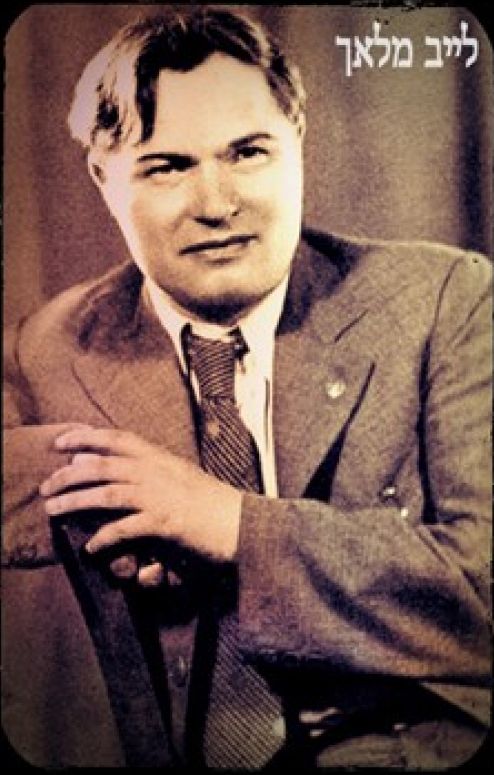
Leib Malach 27 November 1894 - 18 June 1936


I was surprised to find a tribute to Yiddish writer Leib Malach (originally Leib Salzman = Lejb Zalcman), posted on his birthday on Yiddishkeit's web site. It begins:
Leib Salzman (Lejb Zalcman), better known by his adopted name Leib Malach, was born November 27, 1894 in Zwoleń, Radom Gubernia. He moved as a teenager to Warsaw and worked at a variety of odd jobs there. Taken under the wing of the Yiddishist writer H.D. Nomberg, his writing began appearing in the Warsaw press.

He left Poland in 1922, settling and writing for the most part in Argentina, but traveled the world posting dispatches from his travels in the Yiddish press. He died suddenly after an operation in Paris on June 18, 1936.
None of Malach's works have ever been translated into English, except for one fragment of a notorious play. I learned of him via a 1939 Esperanto translation of his last play Mississippi (1936). I documented Misisipi on this blog and digitized a small part of the publication on my web site. But Yiddishkeit found this publication in the UCLA library and posted the image on the cover with its tribute and a caption:


"Malach's final and most performed play was Mississippi (cover of Esperanto translation shown here), which dealt with the 1931 Scottsboro trial. The play was written for Mikhl Weichert's Yung Teater in Warsaw, known for staging contemporary events like the trial of Sacco and Vanzetti."

And here is the original Yiddish play, in various formats: לייב מלאך

On the lower half of the tribute page is the following text, facing Phil Ochs' recording of his famous anti-racist song "Here's to the State of Mississippi":
In honor of Leib Malach’s most famous play, Mississippi, written in the immediate aftermath of the Scottsboro trial, listen to a song from Phil Ochs, written 30 years after the play’s Warsaw production. Here, Ochs brings the theme of justice denied in Mississippi up to 1965.
The slide show also features:
"Amol, Amol" (Once, Once)”: The cover of Malach’s epic poem "Amol, Amol," published in Warsaw, shortly before his emigration. Malach was a successful writer in a number of different genres.

From Spain to Holland: One of Malach’s many travel dispatches, this posthumously-published 1937 book describes Spain on the brink of civil war, fascist Germany, the leftist resistance in Vienna, and other travels throughout Western Europe.
Incidentally, the punchline to Phil Ochs' "Here's to the State of Misssippi" is "Mississippi find yourself another country to be part of."

2017-11-01

Zamenhof interview: Esperanto & Jewish Ideals

Now on my web site:

“Esperanto and Jewish Ideals,” Interview for the Jewish Chronicle with Dr. Zamenhof, The Jewish Chronicle, September 6, 1907, pp. 16-18. Note also the advertisement for "kakao" (cocoa).

With Zamenhof’s translation of ‘La Gaja Migranto’ (published in Fundamenta Krestomatio de la Lingvo Esperanto, 1903), mentioned in the interview.

This interview was translated into Esperanto and published in two parts. Note that R. I. [ = Isidore?] Harris is given as the interviewer:
Intervjuo kun d-ro Zamenhof de R. I. HARRIS, elangligis N. Z. MAIMON, La nica literatura revuo 6/3 (n-ro 33), Januaro-Februaro 1961, p. 82-89.
Intervjuo kun d-ro Zamenhof (fino) de R. I. HARRIS, elangligis N. Z. MAIMON, La nica literatura revuo 6/4 (n-ro 34), Marto-Aprilo 1961, p. 121-127.
Here I noticed interesting details about Zamenhof's thoughts on the Jewish question that I don't recall from other statements. For example, when he describes his attempt to create a new Judaism for the 20th century, he makes two curious assertions: (1) he almost blames his fellow Jews for isolating themselves within the nations in which they find themselves, but (2) he rejects Reform Judaism for excessive accommodation to the gentiles, who don't accept Jews anyway, Zamenhof thus abjures assimilationism as lacking self-respect. His project of Hilelismo (Hillelism, which later morphed into Homaranismo, no longer Jewish-specific and somewhat akin to Ethical Culture) was meant to reject an obsolete territorial (and superstitious) traditional conception of Judaism and modernize it to reflect the ethical ideal (of which monotheism is a part) incorporated in it.

Zamenhof's conception of the causes and cure of ethnic conflict betray an incredible lack of political sophistication. This can be seen most clearly in his paper “International Language” presented to the First Universal Races Congress in 1911. Denying economic causes for national conflict, Zamenhof curiously argues:
Can we say, for instance, that so many millions of poor Russians hate the millions of poor Chinese on economic grounds, when they shed their blood so willingly to defend their Russian oppressors against the attacks of foreigners? Assuredly not, for the Russian soldier knows very well, when he kills a Chinese soldier, that the man would never do him as much harm as the "mailed fist" of his own compatriots. It is not economic causes that give rise to national hatreds.
There is a glimpse of political consciousness in the reference to a group's own oppressors, which immediately disappears. His entire argument is abstract. While correctly denying intrinsic, ineluctable differences between peoples at the basis of animosity, Zamenhof exhibits not an ounce of political or historical consciousness in understanding how these problems came to be or what drives them. What he does show in his various statements is his intimate familiarity with Eastern Europe and the dilemma of Jews in this hostile environment.

This interview in English is invaluable, as the most extensive documentation of Zamenhof's engagement with the Jewish question, outside of his writings in Russian, is in Esperanto. But again, his political cluelessness comes to the forefront.

Zamenhof, soberly and with absolutely no self-aggrandizement, proposed the most far-reaching ambitious projects, all of which failed except for Esperanto, which succeeded in creating an international community of speakers that has survived 130 years, including the century following Zamenhof's death. Zamenhof projected into the future on a grand scale, from the vantage point of a provincial Eastern European Jew chafing at the ghettoization and discrimination that he suffered.

2017-10-18

Witold Gombrowicz on Jorge Luis Borges

Jorge Luis Borges
This might be slightly out of the range of this blog, except that I have blogged in English as well as in Esperanto about both of these writers. But there's another connection, which relates also to interlinguistics, i.e. the history of artificial languages and particularly the ars combinatoria, which I've written about in connection with Borges. Gombrowicz, living in exile in Argentina, encountered Borges and had a low opinion of him, documented in his Diary:

Witold Gombrowicz on Jorge Luis Borges

The following sentence, from an entry in volume 3, 1962, is the reason for me mentioning this here:
What could arouse greater enthusiasm in pure-blooded writers than this kind of bloodless, literary, verbal, unseeing writer who sees nothing except his own mental combinations? [Boldface mine—RD]
Witold Gombrowicz
There is no indication that Gombrowicz has in mind a connection between Borges's combinatorial proclivities mentioned here and the combinatorial logic behind the ars combinatoria or the characteristica universalis, but I made the connection, and that's good enough for me.

2017-05-10

A Seamstress Wants to Learn Esperanto


A Seamstress Wants to Learn Esperanto | YIVO Institute for Jewish Research | The Edward Blank YIVO Vilna Collections Project

May 1, 2017

The publication of Esther Schor's Bridge of Words: Esperanto and the Dream of a Universal Language occasioned this excavation from the YIVO archives.
This application for registration in an Esperanto course offered in the 1930s in Vilna (Wilno) by VILBIG (Vilna Jewish Education Society) was filled out by Tsile Lyubitsh, a young lingerie seamstress. Born in 1911, she was a member of the first generation to have attended one of the new secular Yiddish schools that were established in the wake of World War II.

What motivated Tsile to want to learn Esperanto? One possible clue comes from the memoir of a young Jewish man in Kielce, born in the same year at Tsile. A. Greyno, as he signed his submission to an autobiography contest sponsored by YIVO in the 1930s, was from a poor family. Like Tsile, he was a garment worker, and in his case, a trade unionist. He also dreamed of a world without borders, but more specifically, of a unified world proletariat, and had found a socialist Esperanto organization with which to affiliate [....]

Thank you, YIVO! See also the YIVO Encyclopedia of Jews in Eastern Europe:
Bialystok
Belmont, Leo
Braun, Mieczysław
Gorshman, Shira
Korczak, Janusz
Tuwim, Julian
Zamenhof, Ludwik
Zaretski, Ayzik

2017-04-23

Leendert Cornelis Deij: "Al la Juda Foririnto" / "To the Jew Who Walked Away"

This post commemorates the Holocaust Days of Remembrance in 2017. Holocaust Remembrance Day (Yom Hashoah) marks the anniversary of the Warsaw Ghetto Uprising.

Let us remember also that all of Zamenhof's children were murdered by the Nazis, and Esperanto was targeted as a Jewish conspiracy.

For decades this original Esperanto Holocaust-related poem has been my favorite on the theme of the Shoah. (I discovered some excellent Hungarian Holocaust poetry--some of which also has Esperanto translations--last year, but that is another story.) An English translation received a commendation in a British literary competition. I have reported on the poem, the poet, and the translation on this blog several times previously. I finally obtained the English translation, which I have added to the Esperanto original:

"Al la Juda Foririnto" / "To the Jew Who Walked Away"
by Leendert Cornelis Deij with English translation by Elizabeth Stanley

Note also William Auld's English translation:

Al la juda foririnto / To the Jewish Departed / Al judío que marchó
English translation by William Auld, literal Spanish translation by Fátima Maritela Marinera

Note that I have previously misspelled Deij's middle name, which should read ‘Cornelis’. ‘Leendert Cornelis Deij’ also appears under the names ‘Leen Deij’ and ‘Lodewijk Cornelis Deij’. When I figure out how to correct the subject heading, I will alter it to ‘Leendert Cornelis Deij’.

See also these web pages/sites:


2014-06-19

Postcards from Bialystok


“Postcards from Bialystok” – my third comic book by Joanna Karpowicz is a product of collaboration with The Ludwig Zamenhof Center in Bialystok, Poland. The format is that of the graphic novel. There is some beautiful work here as the outcome of soaking up the history and atmosphere of Bialystok. Naturally, our dear Ludwig and his fellow Jews play a major role.

2014-03-06

Witold Gombrowicz & Esperanto?

Mi komencas legi Witold Gombrowicz, en anglalingvaj tradukoj. Mi legis lian verkon Filozofio en 6 horoj kaj 15 minutoj kaj nun legas la unuan volumon de lia Taglibro.  Ekzistas pri li artikolo en Esperanto en Vikipedio:

http://eo.wikipedia.org/wiki/Gombrowicz

Mi ne povis trovi la ekziston de ajna traduko el lia verkaro en Esperanto. Nu?

Kaptis mian intereson la okupateco je Gombrowicz pri la problemo de provinceco, kiu por li estas pola provinceco. Mi ne konas polan kulturon, do jen nova temo miaflanke, kiun oni certe povas apliki al diversaj situacioj.

Kvankam la elirpunkto malsamas, mi pensas pri eseo de pola Esperantisto:

"Letero el ekster la (E-) kulturo" de Radosław Nowakowski

Ĉu estas koincido, ke ankaŭ Nowakowski estas polo? Li deziras liberiĝi el la katenoj de kulturo. Gombrowicz volis liberigi propran denaskan kulturon el provinceco. La temoj ŝajnas iom apartaj, sed mi supozas ke ekzistas rilato.

Esperanto mem servas diversajn funkciojn. Unu ideologio emfazas la konservadon de naciaj kulturoj. Sed efektive Esperanto ankaŭ servis kiel eskapilo el la sufoko de lokaj cirkonstancoj, aparte en orienta Eŭrope sed ankaŭ aliloke.

Mi komencis blogi pri Gombrowicz anglalingve:

Witold Gombrowicz confronts (Polish) provincialism

Witold Gombrowicz: Philosophy in 6 1/4 hours (1)

2013-02-13

Red Esperanto

Red Esperanto by Paul D. Brazill is a noir novellette set in Warsaw.  It is most readily available in a Kindle edition via Amazon UK. Amazon lets you peek inside the work, and the publisher offers a sample, as well as a product description and author mini-biography.

From the publisher's web site:
In a ghostly and post communist Varsavia, that reminds us of Chicago during the ’30, Luke Case is spending his days with Ukrainian prostitutes, “medium level” gangsters and elderly English professors. During his days built on booze, casual sex and fleeting love, Luke will learn on his own skin that the city is more insidious that he had ever thought.
The product description at Amazon is composed in better English:
Red Esperanto and Death On A Hot Afternoon, written by Paul D. Brazill and published by Atlantis, are part of a series of noir novelettes that are set in various cities around the world. (Also available translated into Italian.)

Red Esperanto: Warsaw.

In snow smothered Warsaw, boozy English hack Luke Case encounters Jolanta, a beautiful young woman with a gangster husband.

Death On A Hot Afternoon: Madrid.

After the brutal events in Red Esperanto, Luke Case escapes Warsaw and heads off to the heat of Madrid where he meets a mysterious torch singer and an agreeing journalist with a violent past.

More Luke Case novelettes are coming soon ...

2012-12-16

Haunted by the Holocaust: The Ghosts of Muranow made visible

The ghosts of Muranow: A journalist's mission to illuminate Poland's haunted past
 By Donald Snyder, NBC News Special Correspondent
 23 Nov 2012


The report begins:
When Polish journalist Beata Chomatowska walks the streets of Muranow, she can’t stop thinking about the horrible things that happened there.

“It’s a daily trauma,” she said.

Present-day Muranow, a district of Warsaw, Poland, is built on rubble and the remains of Jews who perished there during World War II, but many residents are ignorant of the area’s past.

So Chomatowska started a website to educate them called “Stacja Muranow,” which means “Muranow Stop.” And in October she published a book by the same name, chronicling the haunted past of the former Jewish ghetto.

  The stories of the perished, of survivors, of the restoration of historical memory are all interesting.  As yesterday was Zamenhof's birthday, I will point out the following:
Thirty residents have joined Chomatowska’s Muranow education project, meeting in an unfurnished office with no hint of the past. She’s particularly proud of one of the murals painted by members of the group in the entry way of an apartment building. It features prominent Jews who lived in Muranow before the war, such as the creator of Esperanto, Ludwik Zamenhoff, who hoped his universal language would unite people of different cultures.
 All of Zamenhof's children were murdered by the Nazis, but one grandson survived. I had the opportunity to meet Zamenhof's great-granddaughter, now living in Louisiana.

Stacja Muranow [Muranow Station] is a book published in Polish on this project.

Courtesy of the Museum of the History of Polish Jews, you can take an audio walking tour of Muranow in Polish.

And here is the web site devoted to the district: Stacja Muranów strona o Muranowie.