Showing posts with label librokulturo. Show all posts

2017-11-28

Leib Malach 27 November 1894 - 18 June 1936
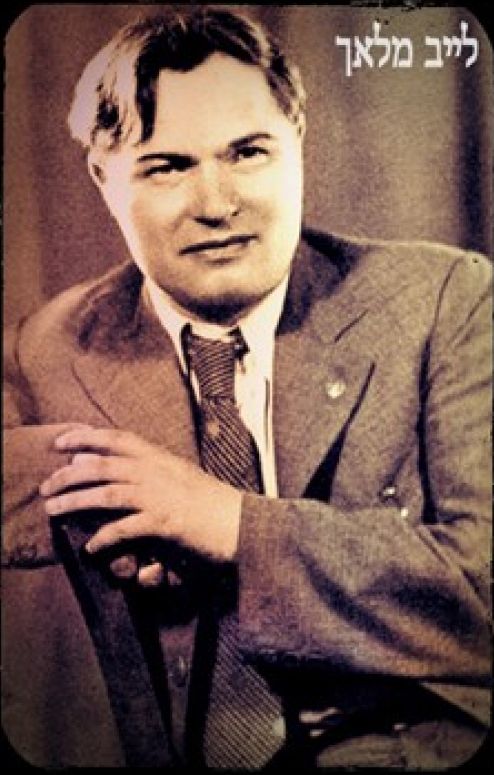

I was surprised to find a tribute to Yiddish writer Leib Malach (originally Leib Salzman = Lejb Zalcman), posted on his birthday on Yiddishkeit's web site. It begins:
Leib Salzman (Lejb Zalcman), better known by his adopted name Leib Malach, was born November 27, 1894 in Zwoleń, Radom Gubernia. He moved as a teenager to Warsaw and worked at a variety of odd jobs there. Taken under the wing of the Yiddishist writer H.D. Nomberg, his writing began appearing in the Warsaw press.

He left Poland in 1922, settling and writing for the most part in Argentina, but traveled the world posting dispatches from his travels in the Yiddish press. He died suddenly after an operation in Paris on June 18, 1936.
None of Malach's works have ever been translated into English, except for one fragment of a notorious play. I learned of him via a 1939 Esperanto translation of his last play Mississippi (1936). I documented Misisipi on this blog and digitized a small part of the publication on my web site. But Yiddishkeit found this publication in the UCLA library and posted the image on the cover with its tribute and a caption:


"Malach's final and most performed play was Mississippi (cover of Esperanto translation shown here), which dealt with the 1931 Scottsboro trial. The play was written for Mikhl Weichert's Yung Teater in Warsaw, known for staging contemporary events like the trial of Sacco and Vanzetti."

And here is the original Yiddish play, in various formats: לייב מלאך

On the lower half of the tribute page is the following text, facing Phil Ochs' recording of his famous anti-racist song "Here's to the State of Mississippi":
In honor of Leib Malach’s most famous play, Mississippi, written in the immediate aftermath of the Scottsboro trial, listen to a song from Phil Ochs, written 30 years after the play’s Warsaw production. Here, Ochs brings the theme of justice denied in Mississippi up to 1965.
The slide show also features:
"Amol, Amol" (Once, Once)”: The cover of Malach’s epic poem "Amol, Amol," published in Warsaw, shortly before his emigration. Malach was a successful writer in a number of different genres.

From Spain to Holland: One of Malach’s many travel dispatches, this posthumously-published 1937 book describes Spain on the brink of civil war, fascist Germany, the leftist resistance in Vienna, and other travels throughout Western Europe.
Incidentally, the punchline to Phil Ochs' "Here's to the State of Misssippi" is "Mississippi find yourself another country to be part of."

2016-05-27

William Auld & malaperintaj retejoj (2)

La plej ampleksa arkivo de literaturo en Esperanto en la Interreto lastatempe malaperis:

Literaturo en Esperanto (Don Harlow)

Literature in Esperanto (Don Harlow) [ligoj al literaturaj revuoj, recenzoj, k.a. / links to literary magazines, reviews, et al]
Mi esperas, ke iu(j) kontaktos la familion de Don Harlow, la konstruinto de ĉi tiu arkivo,ĝ cele al ĝia reaperigo.

Nun, oni serĉu la koncernjan retpaĝojn ĉe la fantom-retejo archive.org.

Laŭokaze, mi retrovos perditajn retpaĝojn kaj reenretigos ilin ĉe mia propra retejo. Se iuj ne troveblos eĉ en la fantomretejo, mi petos kaj ricevos helpon de aliaj kiuj havas la jam bitigitajn tekstojn. Do dankon al Valentin Melnikov pro la jena:

 “Pri la tradukado de poezio” de William Auld

2015-10-06

Frigyes Karinthy en Esperanto (9) ... & in English & French

The author of 50 Watts (whose previous blog was named after Karinthy's work: A Journey Round My Skull) specializes in book design and illustration. He compiled all his former posts on Frigyes Karinthy into one. The editions depicted are English and French translations, and this Esperanto translation:


The respective entry reads:
October 31, 2007: Here's a nice cover for a 1980 edition of Voyage to Faremido in Esperanto.

I sometimes feel like I'm wallowing in obscure books, but a book has to be pretty popular to make it into Esperanto!
This edition of Vojaĝo al Faremido & Kapilario (Hungara Esperanto-Asocio, Budapest, 1980) can be found at the link, and elsewhere on the web.) This is the updated link to that given on the blog.

Also, here is a PDF version:

Vojaĝo al Faremido de Frigyes Karinthy, trad. L. Totsche (Inko, 2003. Revizio de eldono de 1933)


2015-08-30

John Wilkins & irony (3): Adorno postscript

In my first post on this subject, I mentioned:

"Ironic Serif: A Brief History of Typographic Snark and the Failed Crusade for an Irony Mark" by Maria Popova (Brain Pickings)

As it happens, Popova wrote another piece on punctuation concerning an author who commands a great deal of my attention:

Theodor Adorno on the Art of Punctuation by Maria Popova (Brain Pickings)

Adorno took punctuation very seriously, as evidenced by an essay I have not seen: “Punctuation Marks.”
A translation of it by Shierry Weber Nicholsen was first published in the Summer 1990 issue of the poetry journal The Antioch Review and later included in Jennifer DeVere Brody’s altogether excellent Punctuation: Art, Politics, and Play (public library), the essay explores the “definitive physiognomic status” of each punctuation mark, its uses and abuses in the hands of writers, and how punctuation helps shed light on the relationship between language and music which, as we know, worked in tandem to help humanity evolve.

Popova proceeds to detail Adorno's views. Note that Adorno vehemently objected to punctuating ironic remarks. (Note also that she links to her article on the ironic serif.)

Note that Adorno's essay is discussed in Brody’s Punctuation: Art, Politics, and Play, but it is not reprinted there. Adorno's essay was collected in book form here:

Adorno, Theodor W. “Punctuation Marks,” in Notes to Literature; Volume One, edited by Rolf Tiedemann, translated by Shierry Weber Nicholsen (New York: Columbia University Press, 1991), pp. 91-97.

2015-08-28

John Wilkins & irony (2)

I have created a web page with the relevant chapter in Wilkins where he discussed irony, along with a supplementary bibliography and web links:
I have also updated the other two relevant bibliographies:
Here are the most relevant links and references not included in my previous post (but all are included in the web page on Wilkins):

Shady Characters: The secret life of punctuation:
Irony & Sarcasm marks, part 1 of 3 by Keith Houston

Trettien, Whitney Anne. ‘The Sound of the Printed Letter’: Orthography, Orthoepy, Print and Dictionaries in Print Culture. Thesis, Hood College, 2007. See also author’s web site.
‘The Sound of the Printed Letter’: Orthography, Orthoepy, Print and the Naturalization of English Dictionaries. Queen’s University, June 3-5, 2010. Excerpt from full work (above).
The Republic of Codes: Cryptographic Theory and Scientific Networks in the Seventeenth Century by Robert Batchelor, November 1, 1999 [Work in Progress]

Word and Self Estranged in English Texts, 1550-1660; edited by L. E. Semler, Philippa Kelly. Burlington, VT: Ashgate Publishing Company, 2010.

2015-08-25

John Wilkins & irony

You learn something old every day. For close to 50 years I've known about John Wilkins' An Essay towards a Real Character, and a Philosophical Language (London, 1668), but I didn't know about this.

Irony punctuation - Wikipedia, the free encyclopedia

"In 1688, John Wilkins in his famous Essay Towards a Real Character and a Philosophical Language proposed using an inverted exclamation mark to punctuate ironic statements."

The source cited for this tidbit is:

Houston, Keith (2013). Shady Characters: The Secret Life of Punctuation, Symbols & Other Typographical Marks. New York & London: W. W. Norton & Company, Inc., pp. 212–214.

Much more detail is provided here:

"Ironic Serif: A Brief History of Typographic Snark and the Failed Crusade for an Irony Mark" by Maria Popova (Brain Pickings)
In the ancient world, however, humorists relied on their audience’s intellect to detect the irony and didn’t find it necessary to flag it as such. But by 17th-century England, writers had become increasingly restless about pointing out irony readers might miss, and so the first documented punctuation mark denoting irony was born in 1668, the brainchild of the English vicar and natural philosopher John Wilkins — brother-in-law of the royalists’ bête noire Oliver Cromwell, one-time head of Trinity College (of which pioneering astronomer Maria Mitchell wrote in her diaries that “in the opinion of a Cambridge man, to be master of Trinity is to be master of the world”), and eventually appointed as the first secretary of the newly founded Royal Society. Wilkins was a kooky character, who believed the moon was inhabited by aliens, proposed the construction of submarine “Arks,” invented transparent beehives that allowed for the extraction of honey without killing the bees inside, and wrote the very first book on cryptography published in English. But his most memorable accomplishment was the publication of his Essay Towards a Real Character and a Philosophical Language, in which he proposed, two centuries before the invention of Esperanto, a new universal language of letters and symbols — a sort of “steroidal, all-encompassing Dewey Decimal System where concepts were organized into a rigid hierarchy.”
Houston amplifies on the concerns of that era, characterized as "information overload". Popova continues:
What prompted Wilkins to propose this punctuational improvement remains unknown, but we do know that he was neither the only nor the first thinker who pondered the problem. Some sixty years earlier, the revered Dutch Renaissance humanist and social critic Desiderius Erasmus, after whom Rotterdam’s prestigious Erasmus University is named, lamented the lack of punctuation for irony, observing that “irony has no place, only different pronunciation.”

We do not know whether Wilkins was aware of Erasmus' comments. In any case, Wilkins' lesser-known proposal sank along with his highly touted artificial language, which Houston characterizes as the "last best hope" of the philosophical-language movement of the era. The balance of the ill-fated history of the irony mark, which continues to our day, is an equally fascinating story, and the question is addressed as to why it never caught on, even in the Internet era.

Considering that the purpose of the philosophical language movement was to create a logically tight structured means of discourse as an aid to the scientific revolution, it is all the more ironic that Wilkins would also be concerned about irony.

Further research is indicated.

Additional links:

Irony, Humor, & Cynicism Study Guide

Philosophical and Universal Languages, 1600-1800, and Related Themes: Selected Bibliography

An Essay Toward a Real Character and a Philosophical Language by John Wilkins

Ironisigno- Vikipedio

2014-06-19

Postcards from Bialystok


“Postcards from Bialystok” – my third comic book by Joanna Karpowicz is a product of collaboration with The Ludwig Zamenhof Center in Bialystok, Poland. The format is that of the graphic novel. There is some beautiful work here as the outcome of soaking up the history and atmosphere of Bialystok. Naturally, our dear Ludwig and his fellow Jews play a major role.

2013-08-19

Librokluboj & Imre Madách

Kie oni trovu diskutejojn pri beletro en Esperanto interrete?  Ekzistas, mi supozas, pluraj grupoj, sed la jena estas laŭ mia sperto la ĉefa:

per-esperanto-literaturo · Literaturo en kaj per Esperanto

Tamen la grupo plejparte temas pri interŝanĝado de informoj ol analiza diskutado de verkoj.

Jen nova diskutejo:

Librokluboj

Mi partoprenas la jenan diskutgrupon:

I. Madách - Tragedio de l'homo

Ĝis nun la diskutado ne viglas, kaj precipe mi instigas ĝian antaŭenigon. Mi raportos plu almenaŭ pri mia analizo de la verko.

La jena blogo estas efektiva morta, sed troveblas multaj recenzoj:

Lego-klubo de Kvinpetalo

Mi ne memoras, ĉu ekzistas viva retejo por esperantistoj, kiel por anglalingvanoj kiaj Goodreads, kie ĉiuj povas meti recenzojn. Do bonvolu informi se vi scias pri recenzejoj aŭ diskutejoj pri beletro.

2013-07-04

Voynich-manuskripto (3)


The latest:

Mysterious Voynich manuscript has 'genuine message' by Melissa Hogenboom, BBC News, 21 June 2013

The report is based on this study:

Keywords and Co-Occurrence Patterns in the Voynich Manuscript: An Information-Theoretic Analysis by Marcelo A. Montemurro & Damián H. Zanette

Language-like patterns have been discovered, though not the meaning of the text, but the argument is that this isn't gibberish or a hoax, but a meaningful text.

2011-03-28

Lou Harrison: 2 poemoj en Esperanto

Mi antaŭe priskribis ĉi tiun anglalingvan poemaron Ĝojoj & Embarasoj anglalingve. Troveblas fine de la libro Esperantlingvaj tradukoj de du poemoj, jen ĵus enretigitaj:

Nova Odo ("New Ode", tr. Bruce Kennedy)

La Kvar Patronoj de la Palestro ("The Four Patrons of the Palaestra")

Mi ne povis reprodukti la unikan tiparan fasonon "Pluma", kiun adaptis Carter Scholz de originala desegnoformo de Lou Harrison mem. Cetere, mi trovas ĝin iom malfacile legebla en Esperanto. Mi utiligis la iomete ekzotikan tiparan fasonon "Garamond".

Laŭ ekspliko fine de la libro, ekzistas kompleta Esperanta alfabeto en "Pluma", utiligita (kun tipara fasono "Uncial Commoncase") unuafoje ĉi-libre.

2011-03-25

Lou Harrison, graphically & poetically / grafike & poezie

Joys & Perplexities: Selected Poems of Lou Harrison. Winston-Salem, NC: The Jargon Society, 1992. xx, 123, [2] pp. (Jargon; 110) Book design by Lou Harrison and Carter Scholz; interior decorations by Lou Harrison; typography by Carter Scholz; jacket design by Jonathan Williams. After-quotes by Lou Harrison, John Cage, Virgil Thompson. Back cover biographical entry by Ned Rorem.

This beautifully designed and illustrated poetry collection retailed for $20. I found it in an unclassified bargain bin in Strand Books in New York City for $1. From the back matter: here's some background on the book:
With Lou Harrison as its source, it's not at all surprising that there would be a confluence of publishers. The University Library at the University of California, Santa Cruz, its special Collections, which house the Lou Harrison Archive, and the Cabrillo Music Festival, Lou a major force in its founding thirty years ago, join in inspired collaboration with the Jargon Society to publish this book of Lou's poetry.

— Rita Bottoms, Special Collections, University Library, University of California, Santa Cruz

The text of this book is set in Pluma Book. "Pluma" is Esperanto for "of the pen," and the alphabet possesses a complete set of Esperanto characters. The title page and cover are set in Pluma Book and Uncial Commoncase. Both fonts are used for the first time in this book. They are based on drawings by Lou Harrison, and were rendered for the Computer by Carter Scholz.
Here is another sample of the typeface, found on the web:


The poems are in English with Esperanto translations of two poems at the end:

Nova Odo ("New Ode", tr. Bruce Kennedy)

La Kvar Patronoj de la Palestro ("The Four Patrons of the Palaestra")

2011-02-21

Nudismo en Esperantujo (4)


Ĉe blogo da "Naturistaj Arkivoj" onj mencias plurajn numerojn de Naturista Vivo, kun imagoj de unuaj paĝoj kun tabelenhavoj. Aldone aŭ la referencoj donitaj en mia unua blogero, jen pluaj trovitaj.

Naturista Vivo, N-ro 100 (4/2010)

Naturista Vivo
, N-ro 99 (3/2010)

Naturista Vivo
, N-ro 97 (1/2010)

Naturista Vivo, N-ro 94 (2/2009)

Naturista Vivo, N-ro 92 (4/2008)

Naturista Vivo, N-ro 91 (3/2008)

Naturista Vivo, N-ro 89 (1/2008)

Ankaŭ la retejo "Nudist Stop" listigas la enhavon de kelkaj numeroj:

Naturista Vivo, N-ro 100 (4/2010)

Naturista Vivo, N-ro 99 (3/2010)

Naturista Vivo, N-ro 98 (2/2010)

En Esperanto Informilo - Julio 2008 el Berlino enestas artikolo Vanselow kaj la malkovro de la belo, pri Naturista Vivo (numero 89 1/2008) en kiu "troviĝas faktoplena honorigo de la verko de Karl Vanselow (1877-1959), kiu kutime inter Esperantistoj estas konata nur kiel poeto."

Oni trovas la artikolon pri Vanselow ĉe Esperantoplatz, + fragmenton de artikoleto "Peniseto (preskaŭ) cenzurita" + foton de nudamamulino, unupaĝe. Oni trovas du el la tri menciitajn aferojn ĉe Ipernity.

Ĉe blogo Vivi Nude troviĝas imago de paĝo 6 de la revuo Naturista Vivo 89, t.e. fragmento de eseo "Kion vi scias pri libereco?"

Jen raporto pri Naturista Vivo n-ro 63.

Jen eseo "Esperanta naturismo - ĉu libera seksumado aŭ simple nudaj esperantistoj?".

Jen anglalingva intervjuo kun Esperantista naturisto Leif Heilberg:

Leif Heilberg: Naturist Photographer

La Verda Kakatuo de Arthur Schnitzler

Arthur Schnitzler (1862-1931) estis fama juda aŭstria verkisto de teatraĵoj. Antaŭ ol mi spektis iun lian dramon (en la angla lingvo), mi legis la Esperantan tradukon La Verda Kakatuo kaj ege ĝuis ĝin. Tradukis ĝin Johann Schröder (1869-1928), pioniro de la Viena Esperanto-movado, kaj ĝi aperis en 1912. La plej frua angla traduko kiun mi sukcesis trovi (legebla interrete), The Green Cockatoo, aperis en 1913. La originala Der grüne Kakadu aperis en 1899.

Pluraj tradukoj de teatraĵoj de Schnitzler aperis, libroforme aŭ interrete. La artikolo pri Schnitzler en Vikipedio ne mencias La Verdan Kakatuon, sed ĝi mencias aliajn tradukojn. Rondo kaj La Fianĉino haveblas interrete, ankaŭ Hartmut Scheible: Postparolo al Arturo Ŝniclo (Arthur Schnitzler): "La fianĉino" kaj "Sonĝonovelo" kaj Richard Alewyn: Postparolo al A. Schnitzler: Rondo; Amindumo. Ĉiujn tradukis Vilhelmo Lutermano. MAS-anoj povas elŝuti la tuton en formato PDF ĉe la yahoo-grupo de MAS.

Mi ne volas senigi la surprizon je la fino de La Verda Kakatuo. Laŭmemore, temas pri francaj aristokratoj, kiuj ŝatas la senton de ŝajndanĝero en la klubejo La Verda Kakatuo, kie aktoroj rolas minacojn kontraŭ la klientoj. Sed finfine okazas io neatendita . . .

2011-02-19

Nudismo en Esperantujo (2)

Jen ĉe mia retejo la 1-a paĝo de . . .

Naturista Vivo, 2-a jaro, n-ro 5, junio 1962

Vi trovos skanitan (kaj iom plibonigitan) imagon kun transskribo de la teksto, kiu estas traduko el anglalingva artikolo. Komence oni pensus taksi ĝin blaga, sed oni vidos ankaŭ ke temas pri ribelo kontraŭ puritanismo.

Here is page 1 of an Esperanto nudist bulletin from 1962. The lead article by Brooking Tatum was translated from English. While it begins on an unintentionally amusing note, protesting the "misuse" of nudist magazines by a non-nudist (male) reading public, the article reflects an evident rebellion against puritanism.

2011-02-18

Nudismo en Esperantujo (1)

Ni komencu per Vikipedio, kie troviĝas Nudismo kaj Internacia Naturista Organizo Esperantista (INOE), kies organo estas Naturista Vivo. La prezidanto de INOE estas (en 2007) Leif Heilberg en Usono.

La nomo de la organizo iam estis Internacia Naturista Fakgrupo Esperantista (INFE).

La revuo troviĝas eĉ ĉe la International Institute of Social History [Internacia Instituto de Soci-Historio] en Nederlando.

Oni raportas pri Esperantista naturismo en la tiutema anglalingva gazetaro, ekz.:

Leif Heilberg, "Esperanto & Nudism," Paradise Quarterly, Issue Number 2, 1963.

Leif Heilberg, ESPERANTO – THE INTERNATIONAL LANGUAGE, The Bulletin, Volume 12, Number 5, May 1963

Ĉe Naturist archives of the 2010s vi trovos la kovrilpaĝon kaj enhavtabelon de Naturista Vivo, N-ro 99 (3/2010), 2010-08-31.

Ankaŭ aliajn numerojn  oni anoncas tiubloge. Mi listigos ilin en posta blagero. Mi mem havas tutan numeron el 1962: mi skanis la kovrilpaĝon kaj enretigos ĝin.

2011-02-13

Voynich-manuskripto

"La Voynich-manuskripto [vojniĉ] estas mistera skribaĵo, kies aĝo, deveno kaj aŭtoro estas nekonataj." Oni povas esplori plu ĉe . . .

Voynich Manuscript Mailing List 

Estas novaĵo en la esploro de ĉi tiu enigmo:

Experts determine age of book 'nobody can read'
February 10, 2011 By Daniel Stolte, Phys.org
[Ekspertoj konstatas aĝon de libro 'nelegebla']

Estas pluraj hipotezoj pri la manuskripto, sed oni finfine science konstatis, ke ĝi aĝas pli ol jarcento ol antaŭe supozita. La libro restas mistera, sed oni nun scias, ke la manuskripto devenas de la frua 15a jarcento.

2011-02-03

Librokulturo: Historio de la libro

Jen, el la retejo de Kultura Kooperativo de Esperantistoj:

Nia Amiko, La Libro: iom da Historio kaj Kuriozaĵoj

Kompreneble, pri la temo de librokulturo, mi devas inkluvizi ĉi tiun skizon.

2011-01-30

Fan Ĝen, ĉina filozofo & liberpensulo / Fan Zhen (450 - 515 AD), Chinese philosopher & freethinker

It is very difficult to locate information on Fan Zhen in English. I learned about him thanks to Esperanto, which has in many instances served as a bridge language between cultures, filling in gaps where translations cannot be found in national languages. For more details, see this post on my Reason & Society blog:

Fan Zhen (450 - 515 AD), Chinese philosopher

In Ateisto Fan Ĝen [Atheist Fan Zhen], a chapter in Antikvaj Filozofoj de Ĉinio [Ancient Philosophers of China] by Hoŭ Ĝjŭeljang, translated from the Chinese, Fan Zhen is labeled an atheist. He also opposed the putative law of karma and its justification for the existence of rich and poor. There is some detail in this short chapter of the Fan Zhen's ideas of the material basis of the "soul".

*   *   *

Informoj pri ĉina filozofo Fan Ĝen malfacile troveblas en la angla lingvo; mi lernis pri li dankon al Esperanto. Ateisto Fan Ĝen estas ĉapitro en Antikvaj Filozofoj de Ĉinio de Hoŭ Ĝjŭeljang, tradukita el la ĉina. Fan Ĝen estas konata pro sia opono kontraŭ Budhismo kaj negado de la senmorteco de la animo, t.e. efektiva materiismo neanta la apartan ekzistokapablon de la animo. Ĉi tial li suferis ĝenojn en sia socio. Li malakceptis la supozatan principon de karmo kaj ties pravigon de la ekzisto de riĉuloj kaj malriĉuloj. Eble iam mi tradukos ĉi tiun ĉapitron anglalingven.

2011-01-28

Vojaĝo al Kakofonujo

Delonge mi celas akiri fotokopion de rara literatura kuriozaĵo. Ĝi troviĝas en la katalogo de IEMW (Internacia Esperanto-Muzeo en Vieno, Aŭstria Nacia Biblioteko) jene:

Per Turboj Bontonaj en Kakofonujo
dokumentnumero: 704.473-A.Esp-
Per turboj bontonaj en Kakofonujo : fantaziaĵo /
[Joab Eljot]. -
Willoughby, N.S.W.: Sukro, [1937]. - 10 p.
dokumento: multobligaĵo Esperanta

Antaŭ pluraj jaroj mi enketis: IEMW disponigus kopion al mi, sed la kosto inkluzive de poŝtkosto estus troa, kvankam temas pri nur manplano da paĝoj. Ĉu hazarde iu leganto posedas ĉi tiun raraĵon aŭ povus kopii por mi la aferon en biblioteko kaj tiel ŝpari al mi monon?