Showing posts with label jida. Show all posts

2017-11-28

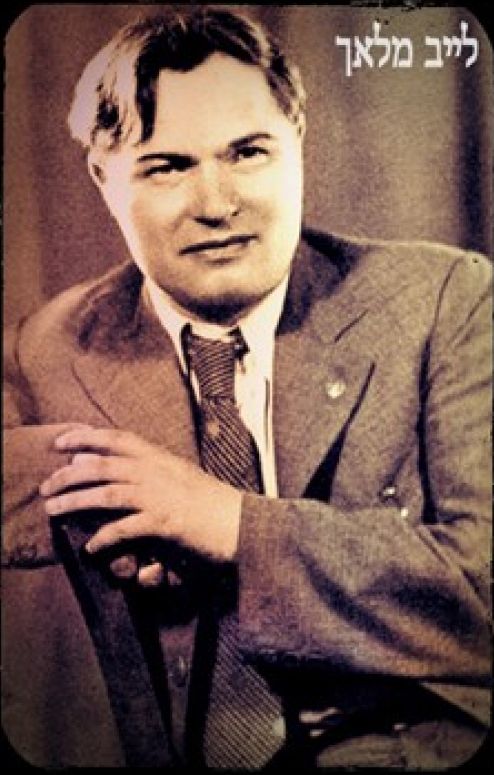
Leib Malach 27 November 1894 - 18 June 1936


I was surprised to find a tribute to Yiddish writer Leib Malach (originally Leib Salzman = Lejb Zalcman), posted on his birthday on Yiddishkeit's web site. It begins:
Leib Salzman (Lejb Zalcman), better known by his adopted name Leib Malach, was born November 27, 1894 in Zwoleń, Radom Gubernia. He moved as a teenager to Warsaw and worked at a variety of odd jobs there. Taken under the wing of the Yiddishist writer H.D. Nomberg, his writing began appearing in the Warsaw press.

He left Poland in 1922, settling and writing for the most part in Argentina, but traveled the world posting dispatches from his travels in the Yiddish press. He died suddenly after an operation in Paris on June 18, 1936.
None of Malach's works have ever been translated into English, except for one fragment of a notorious play. I learned of him via a 1939 Esperanto translation of his last play Mississippi (1936). I documented Misisipi on this blog and digitized a small part of the publication on my web site. But Yiddishkeit found this publication in the UCLA library and posted the image on the cover with its tribute and a caption:


"Malach's final and most performed play was Mississippi (cover of Esperanto translation shown here), which dealt with the 1931 Scottsboro trial. The play was written for Mikhl Weichert's Yung Teater in Warsaw, known for staging contemporary events like the trial of Sacco and Vanzetti."

And here is the original Yiddish play, in various formats: לייב מלאך

On the lower half of the tribute page is the following text, facing Phil Ochs' recording of his famous anti-racist song "Here's to the State of Mississippi":
In honor of Leib Malach’s most famous play, Mississippi, written in the immediate aftermath of the Scottsboro trial, listen to a song from Phil Ochs, written 30 years after the play’s Warsaw production. Here, Ochs brings the theme of justice denied in Mississippi up to 1965.
The slide show also features:
"Amol, Amol" (Once, Once)”: The cover of Malach’s epic poem "Amol, Amol," published in Warsaw, shortly before his emigration. Malach was a successful writer in a number of different genres.

From Spain to Holland: One of Malach’s many travel dispatches, this posthumously-published 1937 book describes Spain on the brink of civil war, fascist Germany, the leftist resistance in Vienna, and other travels throughout Western Europe.
Incidentally, the punchline to Phil Ochs' "Here's to the State of Misssippi" is "Mississippi find yourself another country to be part of."

2017-11-01

Zamenhof interview: Esperanto & Jewish Ideals

Now on my web site:

Esperanto and Jewish Ideals,” Interview for the Jewish Chronicle with Dr. Zamenhof, The Jewish Chronicle, September 6, 1907, pp. 16-18. Note also the advertisement for "kakao" (cocoa).

With Zamenhof’s translation of ‘La Gaja Migranto’ (published in Fundamenta Krestomatio de la Lingvo Esperanto, 1903), mentioned in the interview.

This interview was translated into Esperanto and published in two parts. Note that R. I. [ = Isidore?] Harris is given as the interviewer:
Intervjuo kun d-ro Zamenhof de R. I. HARRIS, elangligis N. Z. MAIMON, La nica literatura revuo 6/3 (n-ro 33), Januaro-Februaro 1961, p. 82-89.
Intervjuo kun d-ro Zamenhof (fino) de R. I. HARRIS, elangligis N. Z. MAIMON, La nica literatura revuo 6/4 (n-ro 34), Marto-Aprilo 1961, p. 121-127.
Here I noticed interesting details about Zamenhof's thoughts on the Jewish question that I don't recall from other statements. For example, when he describes his attempt to create a new Judaism for the 20th century, he makes two curious assertions: (1) he almost blames his fellow Jews for isolating themselves within the nations in which they find themselves, but (2) he rejects Reform Judaism for excessive accommodation to the gentiles, who don't accept Jews anyway, Zamenhof thus abjures assimilationism as lacking self-respect. His project of Hilelismo (Hillelism, which later morphed into Homaranismo, no longer Jewish-specific and somewhat akin to Ethical Culture) was meant to reject an obsolete territorial (and superstitious) traditional conception of Judaism and modernize it to reflect the ethical ideal (of which monotheism is a part) incorporated in it.

Zamenhof's conception of the causes and cure of ethnic conflict betray an incredible lack of political sophistication. This can be seen most clearly in his paper “International Language” presented to the First Universal Races Congress in 1911. Denying economic causes for national conflict, Zamenhof curiously argues:
Can we say, for instance, that so many millions of poor Russians hate the millions of poor Chinese on economic grounds, when they shed their blood so willingly to defend their Russian oppressors against the attacks of foreigners? Assuredly not, for the Russian soldier knows very well, when he kills a Chinese soldier, that the man would never do him as much harm as the "mailed fist" of his own compatriots. It is not economic causes that give rise to national hatreds.
There is a glimpse of political consciousness in the reference to a group's own oppressors, which immediately disappears. His entire argument is abstract. While correctly denying intrinsic, ineluctable differences between peoples at the basis of animosity, Zamenhof exhibits not an ounce of political or historical consciousness in understanding how these problems came to be or what drives them. What he does show in his various statements is his intimate familiarity with Eastern Europe and the dilemma of Jews in this hostile environment.

This interview in English is invaluable, as the most extensive documentation of Zamenhof's engagement with the Jewish question, outside of his writings in Russian, is in Esperanto. But again, his political cluelessness comes to the forefront.

Zamenhof, soberly and with absolutely no self-aggrandizement, proposed the most far-reaching ambitious projects, all of which failed except for Esperanto, which succeeded in creating an international community of speakers that has survived 130 years, including the century following Zamenhof's death. Zamenhof projected into the future on a grand scale, from the vantage point of a provincial Eastern European Jew chafing at the ghettoization and discrimination that he suffered.

2017-05-22

Bridge of Words (1)


I mentioned Bridge of Words: Esperanto and the Dream of a Universal Language by Esther Schor (Metropolitan Books, 2016) in a recent post, but I've been negligent in blogging about it. I am also acknowledged in it, as my web site is an invaluable source for research into Esperanto and its history.

April 14 marked the centennial of Zamenhof's death, which has been commemorated in various ways. (I have begun to blog about this, more to come.) In Zamenhof's lifetime, and for decades afterward, it was necessary to downplay Zamenhof's Jewishness due to the prevalence of Zamenhof, and in fact all of Zamenhof's children were murdered by the Nazis. Esperanto researchers and scholars, writing in Esperanto -- N.Z. Maimon and Adolf Holzhaus come to mind -- began to undo this enforced silence with documentation of Zamenhof's investment and activity in the Jewish world.  This dimension of Zamenhof's Jewish interests and their relation to Esperanto remained even more obscure in the English-speaking world than Esperanto generally. A few years ago Esther Schor began to write and speak about this in the USA. We lectured together at a symposium on Zamenhof on December 15 (his birthday), 2010, at a U.N. building. George Soros made a surprise visit, and while the rest of us got a photo op with him, only he was reported in the mainstream media. I was covered by the Jewish Daily Forward, though.

This book is the latest fruit of Esther Schor's endeavors. It has a strongly Jewish angle which is also bound to be emphasized in some reviews.


Michael Wex is a Yiddishist, known for such books as Born to Kvetch. It is not surprising that he would review this book in The New York Times (November 11, 2016) : "The Jewish Roots of Esperanto." Wex has some criticisms but overall appreciates the subject matter and whets the appetite, and of course highlights the Jewish dimension.


Stuart Schoffman's review "The Great Family Circle" in the Spring 2017 Jewish Review of Books is much narrower, but with some interesting anecdotes. Under the editorship Itamar Ben-Avi, the Jerusalem daily Do’ar Ha-yom published an item about Esperanto on January 23, 1924 and on several other occasions, its obsession with a Jewish renewal notwithstanding. On this date the writer noted that Zamenhof was a Jew, after reporting: "An anti-Semitic weekly in Germany had urged fellow anti-Semites to learn Esperanto, the better to communicate with anti-Semitic organizations in other countries." The short review also mentions Zamenhof's involvement in the proto-Zionist movement.

There is a contrasting pair of comments. The first is a poem from a snotty Zionist ridiculing Esperanto's universalism, Obama, and George Soros. The second is from an Esperantist posting Zamenhof's poem "La Espero" (Hope).


2017-05-10

A Seamstress Wants to Learn Esperanto


A Seamstress Wants to Learn Esperanto | YIVO Institute for Jewish Research | The Edward Blank YIVO Vilna Collections Project

May 1, 2017

The publication of Esther Schor's Bridge of Words: Esperanto and the Dream of a Universal Language occasioned this excavation from the YIVO archives.
This application for registration in an Esperanto course offered in the 1930s in Vilna (Wilno) by VILBIG (Vilna Jewish Education Society) was filled out by Tsile Lyubitsh, a young lingerie seamstress. Born in 1911, she was a member of the first generation to have attended one of the new secular Yiddish schools that were established in the wake of World War II.

What motivated Tsile to want to learn Esperanto? One possible clue comes from the memoir of a young Jewish man in Kielce, born in the same year at Tsile. A. Greyno, as he signed his submission to an autobiography contest sponsored by YIVO in the 1930s, was from a poor family. Like Tsile, he was a garment worker, and in his case, a trade unionist. He also dreamed of a world without borders, but more specifically, of a unified world proletariat, and had found a socialist Esperanto organization with which to affiliate [....]

Thank you, YIVO! See also the YIVO Encyclopedia of Jews in Eastern Europe:
Bialystok
Belmont, Leo
Braun, Mieczysław
Gorshman, Shira
Korczak, Janusz
Tuwim, Julian
Zamenhof, Ludwik
Zaretski, Ayzik

2016-01-19

History of the Literary Cultures of East-Central Europe

Cornis-Pope, Marcel; Neubauer, John; eds. History of the Literary Cultures of East-Central Europe: Junctures and Disjunctures in the 19th and 20th Centuries. 4 volumes. Amsterdam; Philadelphia: J. Benjamins, 2004-2010.

Esperanto is mentioned in vols. 1-3. Vol. 4 mentions Sándor Szathmári.

Vol. 1 (2004): In the article "National operas in East-Central Europe" by John Neubauer (pp. 514 -523), there is a mention of an Esperanto translation (p. 515):

As a touching gesture of compensation, an enterprising Pole published in Paris an Esperanto translation of Włodzimierz Wolski’s libretto for Stanisław Moniuszko’s opera Halka.
Bibliographic reference (p. 620):
Wolski, Włodzimierz. Halka. Esperanto trans. Antoni Grabowski. Paris: Hachette, 1912.
Vol. 2 (2006): In the article "Ashkenaz or the Jewish Cultural Presence in East-Central Europe" by Seth L. Wolitz (pp. 314-331), on the Ashkenazi linguistic panorama (p. 328):
"It was not by accident that an Ashkenazic Jew, Ludwik Lazar Zamenhof, born in Bialystok and at first a Yiddishist, invented Esperanto (hope), a synthetic language designed to serve as an international expression of peace and thus to escape the nationalist baggage weighing any national tongue. Language was thus problematized by Jews around 1900, and the chosen medium indicated an ideological, political, and cultural commitment ranging from nationalist/religious/socialist confrontations around Hebrew and Yiddish, to an accommodationist use of the dominant language of the State, and further to the invention of a new tongue with an implied federalist agenda."
In another article: "Monuments and the Literary Culture of Riga" by Irina Novikova (pp. 40-56), on Russian poet Vsevolod Cheshikhin (pp. 44-45):
"His interest in creating a universal language similar to Esperanto reflected his faith in the internationalism of poetic culture."
From Wikipedia: Pan-Slavic language:
"Neposlava (Непослава) was created by Vsevolod Evgrafovich Cheshikhin (Всеволод Евграфович Чешихин) in 1915 in Nizhny Novgorod, Russia. In 1913 he created a system to construct zonal languages based on Esperanto affixes which are used with national roots and called it Nepo. Then in 1915 he created a nepo-language based on the Slavic lexicon - Neposlava ("Slavic Nepo"). He also used this system to construct other "new Esperantoes" based on Latin-Romance and Germanic languages."
Vol 3: The Making and Remaking of Literary Institutions (2007): From the "General Introduction" by John Neubauer (with Inna Peleva on Bulgaria and Mihály Szegedy-Maszák on Kölcsey and Széchenyi) (pp. 1-38), on competing Hebrew and Yiddish revivals (p. 13):
"The rivalry was unique even on a purely linguistic level, for unlike Croatian and Serbian or Czech and Slovak, Hebrew and Yiddish represented two radically different languages and cultures, both of which lived embedded in other linguistic environments (Russian, Polish etc.) that had reached already more advanced stages in their own awakening. Esperanto was invented by an Ashkenazi Jew, Ludwik Lazarus Zamenhof, as an attempt to overcome this Babel."
Vol. 4: Types and Stereotypes (2010): Introduction to section on women authors (pp. 221-227) in a discussion of dystopias mentions Sándor Szathmári (p. 226):
The most famous East-Central European dystopia R.U.R. (see Veronika Ambros's article in this volume), in which the robots kill off all but one of their makers on a remote island. Since they arenot programmed to generate successors, the robots also seem doomed to extinction, but a love affair between a male and a female robot offers some hope for species survival. The ending resembles that of Imre Madách's Az ember tragédiája (Tragedy of Man; 1862), where Adam, having surveyed the history and the projected future of mankind, wants to commit suicide and thus terminate mankind but is prevented from it by Eve's announcement that she is pregnant. Such pessimistic projections of a future surely qualify as dystopias, even if they do not involve totalitarian visions of society. Dystopic in this sense are also two Hungarian novels, Sándor Szathmári's Kazohinia (1941), one of the most important novels written in Esperanto, and Ferenc Karinthy's Epepe (1971), published in English with considerable success in 2008.

2013-01-18

The Yiddish Policemen's Union (5)

I just finished reading Michael Chabon's The Yiddish Policemen's Union. I don't want to plant major spoilers in this blog, so I will say that there are two major mysteries solved in the end: the nature of the monstrous conspiracy engineered by Litvak, and the murder of Mendel Shpilman. And the subplot of the relationship between  Meyer Landsman and his ex-wife Bina Gelbfish (now Meyer's boss in the police department) assumes a major role in the end.

As to the leading forces behind the conspiracy, there is a true believer, the cynical manipulator Litvak, and perhaps the most powerful faction which in the real world would correspond to the Christian Zionists. But here is what Litvak thinks (p. 345):
In return for providing them with manpower, a Messiah, and financing beyond their wildest dreams, the only thing that Litvak had ever asked of his partners, clients, employers, and associates in this venture was that he never be expected to believe the nonsense that they believed. Where they saw the fruit of divine wishes in a newborn red heifer, he saw the product of $1 million in taxpayer dollars spent secretly on bull semen and in vitro fertilization. In the eventual burning of this little red cow, they saw the purification of all Israel and the fulfillment of a millenia-old promise; Litvak saw, at most, a necessary move in an ancient game--the survival of the Jews.
As Landsman comes face to face with the key player in the American government who facilitates the plot, he is disgusted with the whole game (p. 368):
"Fuck what it written," Landsman says. "You know what?" All at once he feels weary of ganefs and prophets, guns and sacrifices and the infinite gangster weight of God. He's tired of hearing about the promised land and the inevitable bloodshed required for its redemption. "I don't care what it written. I don't care what supposedly got promised to sandal-wearing idiot whose claim to fame is that he was ready to cut his own son's throat for the sake of a hair-brained idea. I don't care about red heifers and patriarchs and locusts. A bunch of old bones in the sand. My homeland is in my hat. It's in my ex-wife's tote bag."

He sits down. He lights another cigarette.

"Fuck you," Landsman concludes. "And fuck Jesus, too. he was a pussy."
On page 372 you will find an account of Landsman's dream about Einstein, chess, Landsman's sister, and the destiny of the Jews.

Bina, like Landsman, realizes the extent to which she is only a pawn. Omitting egregious spoilers, I'm quoting part of what she says to Meyer (p. 375):
"God damn them all. I always knew they were there. Down there in Washington. Up there over our heads. Holding the strings. Setting the agenda. Of course I knew that. We all knew that. We all grew up knowing that, right? We are here on sufferance. Houseguests. But they ignored us for so long. Left us to our own devices. It was easy to kid yourself. Make you think you had a little autonomy, in a small way, nothing fancy. I thought I was working for everyone. [.....]"
A little later Landsman ruminates (p. 280):
Landsman considers the cohort of yids who arrived with his father, those who were not broken by suffering and horror but rather somehow resolved. The former partisans, resisters, Communist gunmen, left-Zionist saboteurs--the rabble, as they were styled in the newspapers of the south--who showed up in Sitka after the war with their vulcanized souls and fought with Polar Bears like Hertz Shemets their brief, doomed battle for control of the District. They knew, those bold and devastated men, knew as they knew the flavor of the tongues in their mouths, that their saviors would one day betray them. They walked into this wild country that had never seen a Jew and set about preparing for the day when they would be rounded up, sent packing, forced to make a stand. Then, one by one, these wised-up angry men and women had been coopted, picked off, fattened up, set against one another, or defanged by Uncle Hertz and his endless operations.
That's about all I can reveal of the plot. As for my overall evaluation, I have come to admire Chabon's fictional achievement. It really does take a lot to write a novel like this. I am not so taken with the nature of the apocalyptic conspiracy that forms the linchpin of the plot, but perhaps that reflects the prevalence now of the theocratic fascism that threatens to destroy the world. Ultimately, this is a meditation on the precarious nature of Jewish identity, which, in the confines of this scenario makes sense, whether or not it would be my main preoccupation in the real world. Chabon's style is quite rich, and he does successfully create a noirish evironment, in which the authenticity of his own Yiddishisms doesn't matter so much.

When you are finished reading the novel, think again about the title.

In addition to the installments of this review, if you follow the subject "Michael Chabon" on this blog, you will find meditations about alternative history and historically oriented novels in general, Jewish and otherwise. I rarely read novels, but before this, I read Ned Bauman's Boxer, Beetle, which featured a seedy lower class Jewish milieu in the East End of London in the 1930s. I don't have much to go on to posit a trend, but I can speculate.

If there is some trend of writing Jewish historical fiction and alternate histories--the ones I know are those in which Esperanto and Zamenhof pop up--it must mean something about an attitude toward the present, as if there were past potentialities according to which things might have turned out differently. But I don't know enough about any of the authors to know their minds, and while I know why Jews and others would be disillusioned with American society or the contemporary world as a whole, I am too far removed from specifically Jewish concerns and their corresponding milieu to know what Jewish authors think about Jews, if generalizations are supportable.

As you know, the whodunit begins with a burned-out, alcohol-besodden detective investigating the murder of a chess-playing junkie in the run-down Hotel Zamenhof in which they both reside. In the end there's a bit of redemption for Meyer Landsman, though not for the society in which he lives. I haven't researched enough of Michael Chabon to know whether Hotel Zamenhof is so named in order to contrast the shabbiness of the reality with the utopian ideal. Zamenhof was a pioneer of the Zionist movement in its earliest stages and renounced it by the time it was becoming a real project, favoring a universalist humanistic project even while still working on the problem of adapting East European Jewry to the modern world. Zamenhof only gets brief mention in the novel as a putative ghost. Perhaps whatever redemption there is must be covered in the grime of hard experience. Perhaps there is at least a reminder of the possibility of redemption in our Hotel Zamenhof?

The Yiddish Policemen's Union (4)

The actual novel Michael Chabon's The Yiddish Policemen's Union comprises 411 pages, including the prefatory quote:
And they went to sea in a sieve -- Edward Lear
But there is also back matter, consisting of a glossary, author's note [acknowledgments] , bio of the author, "The Frozen Chosen" by Patricia Cohen, "Guidebook to a Land of Ghosts" by Michael Chabon, blurbs about Chabon's other fiction, advert for the CD audio of the book performed by actor Peter Riegert.

Cohen's essay, originally published in The New York Times, gives us a portrait of Chabon in the real Sitka, Alaska, along with his thoughts about the construction of his fictional universe. Apparently, in reality Harold Ickes, Secretary of the Interior, actually in 1940 did support opening up the Alaska territory to European Jews. Chabon got in hot water for his essay triggered by his reaction to the 1958 phrase book Say It in Yiddish, and started thinking about an imaginary Yiddishland. Cohen describes the real Sitka and its Jewish and other inhabitants. From the interview with Chabon, we learn that Chabon found an affinity between Isaac Babel in English and hard-boiled detective fiction. Also about Chabon's approach to style:"I felt like I had to invent a whole new language, a dialect." He explains the creation of his own slang as well as his approach to the characters and detective fiction generally.

Cohen was motivated by the themes of destiny and chosenness, and wondering what the world would be like minus the state of Israel. "How mad it seems that this tiny little scrap of land [would be central in global geopolitics] . . . . I have a very strong feeling of complete ambivalence about a world without Israel . . . . I didn't come in with a point to prove or an agenda."

Chabon's 1997 essay on Yiddish, which appeared in Harper's magazine, is reprinted in the book. He takes Uriel and Beatrice Weinreich's Say It in Yiddish as an exercise in futility. As Yiddish had been abandoned by Israel for Hebrew, leaving surviving Yiddish speakers stranded in limbo, the actual application of Yiddish to contemporary situations--booking a plane flight, for example--to be fantasy. Hence Chabon fantasizes about an alternative Yiddish-speaking homeland. Would its denizens be as rough and tough as Israelis? And here is the germ of his future novel. And then he wonders what Jewish Europe would have been like had it been spared the Holocaust.

2013-01-14

The Yiddish Policemen's Union (3)

I've now read 40 chapters, about 360 pages, with six chapters (about 50 pages) to go.

Occasionally my attention has strayed and I lost the thread of what was going on, but it always picked up again and stayed glued for a long while to this whodunit. As a crime novel with pseudo-Yiddishkeit, this is a great read. What its meaning or message is eludes me, but perhaps that too is part of the whodunit.

The plot revolves around detective Meyer Landsman's unrelenting, unauthorized drive to resolve the murder of Mendel Shpilman (a.k.a. Emanuel Lasker) at their common home, the Hotel Zamenhof. The Hotel Zamenhof, born of high ideals, is a seedy, degenerated dive. Perhaps this contrast was intended by Chabon?  Landsman is an unlikely hero, and Shpilman a dodgy candidate for the role for which he was groomed. The Jewish settlement of the Sitka district of Alaska, temporarily reserved for Jewish refugees with its own governing structure but now facing Reversion to Alaskan control, is now endangered. The Jews are not only unsettled by this prospect, but their entire existence is askew, uncomfortable, damaged and wounded, far remote from ideals or utopian visions, compromised not only by their difficult circumstances but by their internal politics and their relations with both the indigenous people and the American government. The worst among the Jews are the ultra-orthodox, who wield illegitimate political power and harbor a gangster element among them. And the manipulation of their religious fanaticism could prove to be the world's undoing.

Perhaps I am not the only one tempted to draw parallels between this alternate history and real history.  But I have no real clue as to Chabon's intent.

There is a history of struggle between the Jews and the Tlingit, with multiethnic offspring and antagonistic friendships in the mix, as one would expect. Here is an extract from one colorful exchange illustrating the situation (p. 283):
[....] "Johnny the Jew," he says. "Well, well. Beanie and all. Clearly you haven't had any difficulties lately saying the holy blessing over the Filipino donut."

"Fuck you, Dick, you anti-Semitic midget."

"Fuck you, Johnny, and your chickenshit insinuations about my integrity as a police officer."

In his rich but rusty Tlingit, Berko expresses a wish to one day see Dick lying dead and shoeless in the snow.

"Go shit in the ocean," Dick says in flawless Yiddish.

They step toward each other, and the large man takes the small one into his embrace. [....]
There's more to this priceless dialogue. Dick also has more to say about his boundless suspicion of Jews (285).

There is more to the linguistic mix as well, as Jews of different social origins have different linguistic peculiarities.  Here is an example of something new to Landsman (p. 286).
"Hebrew?" Berko says. "Mexicans speaking Hebrew?"

"That's what it sounded like to me," Landsman says. "Not synagogue Hebrew, either." Landsman knows Hebrew when he hears it. But the Hebrew he knows is the traditional brand, the one his ancestors carried with them through the millennia of their European exile, oily and salty as a piece of fish smoked to preserve it, its flesh flavored strongly by Yiddish. That kind of Hebrew is never employed for human conversation. It's only for talking to God. If it was Hebrew that Landsman heard at Peril Strait, it was not the old salt-herring tongue but some spiky dialect, a language of alkali and rocks. It sounded to him like the Hebrew brought over by the Zionists after 1948. Those hard desert Jews tried fiercely to hold on to it in their exile but, as with the German Jews before them, got overwhelmed by the teeming tumult of Yiddish, and by the painful association of their language with recent failure and disaster. As far as Landsman knows, that kind of Hebrew is extinct except among a few last holdouts meeting annually in lonely halls.
I have no idea whether these graphic analogies are apt for any variant of Hebrew or Yiddish. They do in any case illustrate Chabon's vivid style, and they are suggestive of the social/political realities associated with these languages. Note also the reversal of the fates of Yiddish and Hebrew. Remember that in this alternative history the fledgling state of Israel is destroyed, and the Yiddish-speaking Jews dominate the Jewish settlement in Sitka.

The generation that settled in Alaska found a great disparity between the imagined fables of Alaska and the reality found there. Its songs mark this disillusionment. (291)
Two million Jews got off the boats and found no rolling prairies dotted with buffalo. No feathered Indians on horseback. Only a spine of flooded mountains and fifty thousand Tlingit village-dwellers already in possession of most of the flat and usable land. Nowhere to spread out, to grow, to do anything more than crowd together in the teeming style of Vilna and Lodz. The homesteading dreams of a million landless Jews, fanned by movies, light fiction, and informational brochures provided by the United States Department of the Interior--snuffed on arrival. Every few years some utopian society or other would acquire a tract of green that reminded some dreamer of a cow pasture. They would found a colony, import livestock, pen a manifesto. And then the climate, the markets, and the streak of doom that marbled Jewish life would work their charm. The dream farm would languish and fail.
Just a story, or is there more behind Chabon's fictional creation?

2012-12-23

The Yiddish Policemen's Union (2)

I've now read 22 chapters of Michael Chabon's The Yiddish Policemen's Union, approaching 200 pages.The plot moved quite slowly as the overall scenario of the Jewish colony in Alaska was in the process of being laid out step by step. Chabon's use of language is quite adroit, and his capacity for description is quite rich. Note that the narrative is written in the present tense, rather than in the past tense as is customary in the English language. I cannot comment on Chabon's dialogue, except for noticing some clever turns of phrase, as I am not conversant with Yiddish culture to judge how he re-creates it in his alternate universe.

The novel is heavily sprinkled with yiddishisms, which I do not understand. The characters, particularly the main character Landsman, always refers to Jews as 'yids'.  Whether or not this is a derogatory term in context I do not know, but it does not sound very flattering.

There are references to real-world Jewish public figures. There is a Max Nordau (pioneer Zionist) Street and a Peretz (I. L. Peretz, Yiddish poet) Street. There is an Einstein Chess Club. The murder victim who is the focal point of the plot is pseudonymously known as Emanuel Lasker (named after a chess champion, who also wrote about other games, e.g. Go).

The Jewish society we see here is not very attractive. There's a low class seediness about it, that begins with the run-down Zamenhof hotel, and the vista of crudity spreads out from there.The orthodox fanatics are referred to as 'black hats'. The Verbovers have their own island, and regard Landsman, who is there investigating the murder, as an interloper, and there is no love lost on his part either. They have inordinate political influence, and there is a fraction of them involved in organized crime. The Jews' relations with the Indians, i.e. the indigenous Alaskans, is none too friendly, either. The overall picture is not pretty. Other than storytelling, if there is a thematic purpose to Chabon's narrative, I do not know yet what it is.

Landsman is divorced, but his ex-wife Bina becomes his boss in the police department. Word comes down to scotch the murder case, but he can't leave it alone.  The Jewish settlement faces Reversion, which presumably means the loss of the Jewish franchise of the colony, which means a certain percentage of the Jewish residents will have to disperse.  Israel itself was destroyed in 1948. An interesting alternate history scenario, to be sure.

There is only one place so far where we learn more about the political factions that once were part of the fabric of the colony (p. 76):
For forty years--as Denny Brennan's series revealed--Hertz Shemets used his position as local director of the FBI's surveillance program  to run his own private game on the Americans. The Bureau first recruited him in the fifties  to fight Communists and the Yiddish Left, which, though fractious, was strong, hardened, embittered, suspicious of the Americans, and, in the case of the former Israelis, not especially grateful to be here. Here Shemetz's brief was to monitor and infiltrate the local Red population; Hertz wiped them out. He fed the socialists to the Communists, and the Stalinists to the Trotskyites, and the Hebrew Zionists to the Yiddish Zionists, and when feeding time was over, he wiped the mouths of those still standing and fed them to each other. Starting in the late sixties, Hertz was turned loose on the nascent radical movement among the Tlingit, and in time he pulled its teeth and claws, too.
As much care as Chabon takes to delineate this society, I found my attention flagging after a while, until, while visiting the Verboters, Landsman confronts the rebbe with the death of 'Emanuel Lasker', whose real identity has just been uncovered. From there I've been riveted to the narrative.

Now on to the Esperanto references.

'Elevatoro', an Esperanto word which appears twice so far, does not really mean 'elevator' in the sense of transporting people: that would be 'lifto'. An 'elevatoro' is more like a winch that lifts cargo.

Hotel Zamenhof is a centerpiece of the narrator. As for Zamenhof the man, he is thought to be a ghost:
"You know what Kohn says," says Tenenboym. Kohn says we got a ghost in the house." Kohn is the day manager. "Taking shit, moving shit around. Hohn figures it for the ghost of Professor Zamenhof."

"If they named a dump like this after me," Landsman says, "I'd haunt it, too."

"You never know," Tennenboym observes. "Especially nowadays." [pp. 12-13]
Much later, while Landsman is on forced leave while recovering from a bullet wound, his ex-wife Bina visits his hovel in the Hotel Zamenhof:
She wades through pieces of Landsman's gray suit and a bath towel and stands at the foot of the bed. Her eyes take in the pink wallpaper patterned with garlands in burgundy flock, the green plush carpet with its random motif of burn spots and mystery stains, the broken glass, the empty bottle, the peeling and chipped veneer of the pressboard furniture. Watching her with his head at the foot of the pull-down bed, Landsman enjoys the look of horror on her face, mostly because if he doesn't, then he will have to feel ashamed.

"How do you say 'shit heap' in Esperanto?" Bina says. She goes over to the veneer table and looks down at the last bedraggled curls of noodle pudding lying in the grease-streaked clamshell. [pp. 163-164]

2012-12-13

The Yiddish Policemen's Union (1)

Opening sentence of Michael Chabon's novel The Yiddish Policemen's Union:

"Nine months Landsman's been flopping at the Hotel Zamenhof without any of his fellow residents managing to get themselves murdered."

The hotel of course is named after L.L. Zamenhof, creator of Esperanto, whose 153rd birthday is coming on December 15. So in honor of Zamenhof's birthday, I begin reading this alternate history novel. Is alternate history good for the Jews?

"Landsman puts his hand on Tenenboym’s shoulder, and they go down to take stock of the deceased, squeezing into the Zamenhof’s lone elevator, or ELEVATORO, as a small brass plate over the door would have it. When the hotel was built 50 years ago, all of its directional signs, labels, notices, and warnings were printed on brass plates in Esperanto. Most of them are long gone, victims of neglect, vandalism, or the fire code." [p. 3]

Omaĝe al la venonta naskiĝtago de Zamenhof, mi komencas legi ĉi tiun ukronian romanon (La Jida Policana Sindikato/Unio), en kiu situas Hotelo Zamenhof.

2012-11-30

Nova jida artikolo pri Esperanto / New Yiddish article on Esperanto

Ĉu la angla venkos la mondon; ĉu aliaj lingvoj malaperos aŭ konserviĝos nur en muzeoj? Nu, judoj respondecas pri Babelo. Unu solvonto de la lingvo-problemo estis Zamenhof, kies judeco estis nepra motivo al kreado de Esperanto. Esperanto similas socie al la jida. Laŭ amiko de la aŭtoro, Esperanto estas la jida de la gojoj.

Do jen eta resumo de Esperanto kaj Zamenhof en jida usona ĵurnalo (kun anglalingva eldono, sed ĉi tiu artikolo ne havas anglan version) ankoraŭ eldonata:

The Jewish Daily Forward / פֿאָרווערטס
23 Nov 2012:

 
דער נײַער עספּעראַנטאָ
 [The new Esperanto / La nova Esperanto by/de Alec Burko]
 לייזער בורקא

2012-06-21

Esperanto in the Jewish Daily Forward

Se oni serĉas la Jewish Daily Forward [Juda Ĉiutaga Antaŭen (ĵurnalo)], oni trovos plurajn artikolojn pri Esperanto aŭ menciante Esperanton.

Mi jam blogis kelkfoje reference al ĉi tiu ĵurnalo. Jen:

Esperanto, the 'Worldwide Yiddish'
By Gary Shapiro
The Jewish Daily Forward, December 21, 2010

Temas pri Zamenhof-Simpozio ĉe UNo, en kiu mi prelegis.

Laughing in the Face of Evil (On the Shortlist for the Sami Rohr Prize, Joseph Skibell Uses Writing and Farce in the Face of the Holocaust), by Laura Hodes, The Jewish Daily Forward, published May 18, 2011, issue of June 3, 2011.

The Art of Tempting Memory To Speak
By Benjamin Balint
The Jewish Daily Forward, April 23, 2004,
[recenzo de / review of Feathers by Haim Be’er]

Skibell kaj Be'er verkis romanojn en kiu rolas esperantistoj.

Seeking Mameloshn Down South by Ilan Stavans
The Jewish Daily Forward, published December 05, 2003, issue of December 05, 2003.

Inkluzivas diskuton pri Lejb Malaĥ (Leib Malach), kies verko Misisipi legeblas en Esperanta sed ne en angla traduko.

Mi blogos pri pluaj artikoloj.

2011-03-13

Izrael Lejzerowicz

Izrael Lejzerowicz (1901-1942) estis pol-juda esperantisto kiu verkis originale kaj traduke and estis murdita kun la familio en nazia ekstermejo. Li plej famas pro lia satiro El la "Verda Biblio" (eldonita kun "Babiladoj kun Horaĉo Serĉer", 1935) Oni trovas en OLE similajn informojn kaj ankaŭ recenzon Grimaco antaŭ la pereo de Sten Johansson.

Jen interrete:

El la "Verda Biblio" & Babiladoj kun Horaĉo Serĉer

IZRAEL LEJZEROWICZ (1901-1944) de Vilmos Benczik
El la "Verda Biblio" (sonregistraĵo)

La sorĉistino el Kastilio de Тalom Asch, kun permeso de la aŭtoro el juda lingvo tradukis I. Lejzerovicz. Budapest: Literatura Mondo, 1933.

La biblia verde, Esperantaj Bitoj, 19 januaro 2010.

2011-01-10

Alternate history, Jewish cognitive dissonance, & the Yiddish revival

Two State Dissonance
Gershom Gorenberg | The American Prospect, June 11, 2010

Meyer Landsman lives in the Hotel Zamenhof. Landsman is the hero of Michael Chabon's The Yiddish Policemen's Union, in which the Jews lost the 1948 war in Palestine and have taken refuge in a Jewish autonomous region of Alaska. The run-down hotel is named for L.L. Zamenhof, the Russian-born Jew who invented Esperanto in order to bring world understanding and peace. In other words, Landsman's residence is a liberal Jewish dream that has seen much better days.
The turn to alternate history fiction is seen by Gorenberg as the outcome of cognitive dissonance among frustrated liberal Jews who can't see themselves in today's Israel.
What strikes me as I listen to the family fight between the hawkish Jewish establishment and other American Jews—the pro-peace Zionists, the furious anti-Zionists, the "don't ask me about Israel" non-Zionists—is that they're all dealing with a shared family problem: They have a hard time fitting Israel as it actually is into some of their deepest assumptions about the world. The easiest way for me to explain runs through Philip Roth's The Plot Against America and Chabon's Yiddish Policeman's Union.

While most Jews repress the disparity, Roth and Chabon make it very clear—by describing the world as it would be if the facts lined up with the beliefs. Roth describes an America that fits the assumption that Jews are at peril everywhere. Chabon invents a world in which the Jews are still weak and homeless. On one level these visions are dystopian—but on another they are somehow comforting, homey, because the gap between different things we "know" is gone.
I'm not going to comment on the rest of Gorenberg's political meditation. The non-religious Yiddish revival belongs to a different mental universe from what has become of the revival of Hebrew, itself a remarkable accomplishment, now associated with a powerful state far removed from the shleppers who might have once fantasized about it.

See also:

Yiddish is no joke
Antony Lerman, The Guardian, 5 March 2010

"The revival of this death-defying language shows that Zionism has failed to consign other forms of Jewish life to oblivion"

The Zionist movement was no friend to Yiddish, but now Yiddish is making a comeback. There's one comment on Zamenhof, Yiddish, and Esperanto.

2010-12-24

Lejb Malaĥ pri Misisipi: de la jida al Esperanto

Antaŭ pli ol jaro mi skanis & enretigis la jenan:

Misisipi de Lejb Malaĥ (1894-1936) (Antaŭparolo & Biografio)

Poste mi kopodis iom esplori pli pri Malaĥ en la angla lingvo. Oni povas legi ĉi tiun jidan dramon en Esperanto sed ne en la angla. Unu mia precipa rimedo informi al diversaj anglalingvaj publikoj estas verki pri historiaj, kulturaj, literaturaj, aŭ filozofiaj temoj en rilato kun Esperanto.

Do finfine mi ĵus verkis anglalingvan blogeron (tuj antaŭe) ĉi-teme.

Malaĥ restis aŭ vojaĝis en diversaj landoj de Pollando ĝis Argentino ĝis Usono ĝis Palestino ĝis Francio. Li vekis publikan konscion pri la juda sklaviga sekskomerco en Argentino en 1926 per sia dramo Ibergus (Remuldado). Lia lasta publika verko estis Misisipi, kiun oni tradukis el la jida en la hebrean kaj laŭraporte la francan. En 1934/5 oni ludis la teatraĵon pli ol 300 fojojn en Pollando.

La esperantisto I. Jurysta priskribas en la antaŭparolo siajn motivojn por la traduko. Li forte kondamnas la usonan rasapartigan sistemon kaj la persekutadon de usonaj negroj. Li montras la klasbatalan perspektivon. Inter alia, li diras:
Tradukinte tiun ĉi verketon el la juda lingvo Esperanten, mi celas per ĝi montri la fratecan kunsenton kaj simpation de subpremata kaj persekutata popolo al samsorte malamata raso. Miaopinie, ĝuste en la nuna epoko, kiam la ĉiondetruanta faŝismo kaj naciismo penas disigi la homaron per incitado de plej malnoblaj instinktoj de popol‑ kaj rasmalamo, necesas pli ol ĉiam vekadi la klaskonscian solidarsenton inter ĉiuj laboruloj de ĉiuj rasoj sur la tuta terglobo por detrui per komunaj fortoj kaj bari la vojon al la freneziĝanta rasismo.
Ĉi tiun Jurysta verkis en 1939, sojle de la mondmilito. Post ses jaroj, lia popolo kaj kulturo estus ekstermitaj. Post aldonaj 20 jaroj, la usona rasapartiga sistemo estus leĝe renversata.

Do mi kaptas la okazon rememorigi la verkiston Malaĥ, kaj ni fieru ke oni konservas spurojn de lia vivo per Esperanto.

(Dekstre: Lejb Malaĥ)

A Yiddish play you can read in Esperanto but not in English

I'm talking about . . .


"Misisipi" de Lejb Malaĥ (1894-1936) (Antaŭparolo & Biografio) 

The foreword and biographical sketch, written in Esperanto, taken from this 1939 Esperanto translation, can be found on this web page. I have yet to find much about this play in English. Here's a tidbit:
Leib Malach (Malekh or Malaj; b. 1894 Zvolin, Poland; d. 1936 Paris) was the pseudonym of Leib Zaltsman; Malach, his mother's first husband's surname, means “angel” in Hebrew. During World War I he published his first literary pieces, a ballad in the Warsaw Yiddish daily Varshever Togblat. In 1922, Malach moved to Argentina, and in 1926, he traveled throughout South America and settled for a year and a half in Brazil. Malach's last play to be produced during his lifetime, Mississippi, was translated into Hebrew, French and Esperanto.
SOURCE: Yiddish South of the Border: An Anthology of Latin American Yiddish Writing; edited by Alan Astro, with an introduction by Ilan Stavans (Albuquerque: University of New Mexico Press, 2003), p. 92.
Here you can also find an excerpt from Malach's play "Remolding" (pp. 92-98). See also Jacob Botoshanski, Director's Prologue to Leib Malach's play "Remolding" (pp. 89-91). (This anthology's table of contents can be easily viewed and copied, here.)

There is a paragraph on Malach in the Jewish Virtual Library.


You can learn more about Malach's incendiary works in The Jewish White Slave Trade and the Untold Story of Raquel Liberman by Nora Glickman. Malach's 1926 play Ibergus (Remolding) was instrumental in combating the Jewish white slave trade in Buenos Aires and ejecting the sex trade underworld from the Yiddish theater.

Here is more on this scandalous commerce and its spillover into the Yiddish theater:

Caftens, Kurvehs, and Stille Chuppahs: Jewish Sex Workers and their Opponents in Buenos Aires, 1890-1930 by Mir Yarfitz (Perush, Vol. 2, 2010)

Here is more background on Remolding:

The King of Lampedusa and Remolding by Joel Berkowitz

Farmitlung and Shtadlones in Latin American Yiddish Literature by Alan Astro

Here is an abbreviated introduction to Astro's anthology:

Seeking Mameloshn Down South by Ilan Stavans

If you can read Spanish, you're in luck:

Nora Glickman, “Regeneración” de Leib Malach y la trata de blancas, Buenos Aires: Pardés, 1984.

Otherwise, you'll have to read Malach's works in the Yiddish originals.

There are additional biographical details accompanying the Esperanto translation Misisipi. In 1934 or 1935 this play was performed on more than 300 occasions in the major theaters of Poland (I assume in the Yiddish original.) The play was also translated into Hebrew.

The Esperanto translator, I. Jurysta, sets the stage by portraying the horrendous conditions under which Black Americans live in the Jim Crow South, including the rule of lynch-law. The play itself is based on the real-life "Scottsboro Boys" case of the 1930s. Jurysta is unsparing in his indictment of white racism and the capitalist system, as he is perplexed by the rising tide of fascism and nationalism in Europe.
Translating this work from the Yiddish language into Esperanto, I aim to demonstrate the fraternal fellow-feeling and sympathy of a suppressed and persecuted people for a hated race undergoing the same fate. (My translation)
Malach died in 1936. The translator wrote these lines in 1939. Within six years, the Jewish population of Eastern Europe would be exterminated and its culture with it. It would take an additional 20 years for the passage of civil rights legislation in the USA to begin to put an end to Jim Crow.
The only writer of history with the gift of setting alight the sparks of hope in the past, is the one who is convinced of this: that not even the dead will be safe from the enemy, if he is victorious. And this enemy has not ceased to be victorious.

— Walter Benjamin, “Theses on the Philosophy of History”, 1940

2010-12-21

Zamenhof Symposium at UN, George Soros, & me (3)

Here is a video from the Dec. 15 Zamenhof symposium at the UN:

George Soros on his father Teodoro/Tivadar & the Esperanto publishing house "Literatura Mondo" /
George Soros pri patro Teodoro-Literatura Mondo


See photos in Albums / Jen fotoj en albumoj:

Zamenhof to Soros Symposium 2010: 116 photos / fotoj
Soros Z-Simpozio: 13 photos / fotoj

Here is one photo / Jen ekzemplo:


Today on the web! / Ĵus aperis:

Esperanto, the 'Worldwide Yiddish'
By Gary Shapiro
The Jewish Daily Forward
December 21, 2010
http://blogs.forward.com/the-arty-semite/134095/

I am featured prominently in this article.

2009-12-13

L.L. Zamenhof's 150th birthday

Ludwig Lazarus Zamenhof (1859-1917), is best known as creator of the Esperanto language. December 15 marks the 150th anniversary of his birth. Tonight I will get to meet his great-granddaughter, whose very existence is a near miracle.

I will broach the subject by enumerating three recent bibliographies/web guides I've compiled. Incidentally, I've learned, not much to my surprise though indeed to my disgust, that I can't bring up the subject of Jews in any context without being immediately assaulted by bigots. These additional bibliographies reveal more of the extent of my interests.

My first bibliography:

Marxism & the Jewish Question: Selected Bibliography
http://www.autodidactproject.org/bib/jews-marxism.html

This material is testing ground for a number of projects. Not only in terms of overt politics, but conceptually, how was historical materialism sufficiently evolved or not at any given stage or within any given tendency to explain exactly what bound the Jewish people--specifically of Europe (and more specifically of Eastern Europe, where conditions were worst)--as a people? Could historical materialism adequately encompass culture, and conversely, what did the culturalists leave out in their conceptualization of their situation?

On the plane of overt politics, one will find an emphasis here on the conceptions and policies of the Bolsheviks as compared to the Jewish Bundists (on which there is a thought-provoking new book out).

This is, however, only a portion of the elements needed for a full analysis. The late 19th century and early 20th century were filled with schemes of religious, cultural, linguistic, and political reform and radicalism. There were currents not only of socialism and Marxism, but of assimilationism, Zionism, cultural autonomism, liberalism, Haskalah (the Jewish Enlightenment)--formulated and argued by Jewish intellectuals, all involving different conceptions of the nature of the past and contemporaneous communities of European Jews and prospects and programs for their future. I attempted to cover as many of these currents as I could in my second bibliography:

L. L. Zamenhof & the Cultural, Religious, Professional & Political Context of 19th-20th Century Eastern European Jewish Intellectuals:
Selected Bibliography
http://autodidactproject.org/bib/jews-19thcent.html

Juxtaposing these two bibliographies suggests the extensiveness and complexity of the ideological ferment of the time, a topic which stands on its own, though the intellectually vacuous, ideologically degenerate, and juvenile politics of the present would gain some perspective from a study of this past.

Finally, all of this is related to a specific project. December 15 will mark the 150th birthday of the creator of the Esperanto language, L. L. Zamenhof, a product of this ferment. Tonight I will have the opportunity to meet Zamenhof's great-granddaughter, itself a remarkable occasion, all the more amazing because all of Zamenhof's children were murdered by the Nazis, and his grandson, a child at the time, escaped their clutches twice by a hairsbreadth (once under the protection of a Catholic priest), to eventually produce two daughters. Though Zamenhof is known mostly for the creation of Esperanto, underlying that project was a more general program of cultural and religious reform, all stemming from Zamenhof's preoccupation with the Jewish question.

Traumatized by the pogroms of 1881, Zamenhof, still a medical student, joined the early Zionist movement and embroiled himself in its debates. At the time various options--all utopian--were considered. Zamenhof opposed establishing settlements in the territory that is now Israel, and favored settlement in America. Ultimately he rejected Zionism altogether, and argued vigorously for years afterward that the project of settling in the Middle East would be either impracticable or disastrous. Another project involved the reform and standardization of Yiddish. (Zamenhof was born in the same year as Sholem Aleichem.) He gave up on that as well. In 1887 he published his first book outlining the basics of Esperanto. As the Esperanto movement took off internationally, he published two treatises in Russian under a pseudonym, in 1901, outlining a program for religious reform and a doctrine called "Hilelismo", inspired by Rabbi Hillel's famous aphorism concerning the golden rule as the essence of religion. Here the influence of Enlightenment thought (Haskalah) is evident, as Zamenhof rejects ancient superstitions and outmoded practices. However, Zamenhof's arguments were even more trenchant. Not only does he demolish the case for Zionism in every way possible, but he engages in a merciless demystification of the Jewish people, questioning the continuity that allegedly connects the Jewish people of today with their ancient homeland, and even questions the basis of their commonality across different nations and regions in the present.

Zamenhof enquires as to what binds peoples together in general, and in the case of Jews in particular. He settles on language and religion as the two shaping principles of peoplehood. This is the very obverse of historical materialism, as Zamenhof completely ignores material factors and concentrates all of his attention on cultural issues (I suppose what is now called by some "imagined communities"). Zamenhof rejects nationalism and in particular nationalistic religion. But curiously, he also pooh-poohs the culturalist Yiddishist option, which would be the logical choice for secularists who reject assimilation (as did Zamenhof). Yiddish is now just a "jargon" in his eyes; Hebrew is not (in 1901) a living language, and the Jews are a "pseudo-people", martyring themselves for a faith they can no longer believe in, and immersed in a nostalgia for a lost civilization with which they no longer have a substantial connection. Hence, a radical cultural reform is necessary, with a radically reformed religion for modern times, sustaining a connection between the intellectuals and the masses, aiming to create a modern, "neutrally-human" people for a cosmopolitan world. By this time Zamenhof sees Esperanto as the binding language, not a reformed Yiddish.

These ideas got Zamenhof into hot water with all parties concerned, both in Jewish circles and in the Esperanto movement, now internationally established, with its center of gravity having shifted from Eastern Europe to France. Within a few years his project underwent another transformation, and "Hilelismo" for the Jews was generalized to "Homaranismo" for everyone. ("Homaranismo" is not literally translatable but means being a member of the human family). Homaranismo bears similarities to Ethical Culture or Unitarianism, but has its own spin, intended as a mediator between inherited traditions and modern secularized consciousness, and between members of different religious traditions. While Esperanto thrived, Homaranismo sank like a stone. Zamenhof's prospective for either the Jews or of all of humanity based on linguistic and religious reform belongs to an alternative history, a timeline in a parallel universe for a strategy that had no chance in this one.

Zamenhof attempted a few other types of public interventions, a contribution to the Universal Races Congress of 1911, and a call to diplomats in 1915, proposing what nations should look like after the war. Zamenhof died in 1917.

There is a postscript to this story. Following the war, a separate workers' Esperanto movement sprang up and remained vigorous, until it was largely killed off by Hitler and Stalin. There arose within it two major factions--the anarchists/anationalists and the Soviets and their supporters. Zamenhof's idealist notions of society were criticized by Soviet Esperantists using the analytical tools provided by Soviet Marxism. They did not, however, wrestle with the Jewish question or delve into Zamenhof's specific arguments with respect to it. In any case, Zamenhof's Jewish origin was such a sensitive topic up to that time that scholars only delved into it substantively decades later.

Thus my third bibliography:

Zamenhof & Zamenhof Studies Web Guide (Zamenhof kaj Zamenhofologio)
http://autodidactproject.org/bib/zamenhofologio.html

Only a smattering of documents listed are in English, but some do tell this story, particularly in the sections on Hilelismo/Homaranismo & Jewish affairs.

Pursuing any portion of the intellectual terrain mapped out by these three bibliographies/web guides can be related to a number of conceptual issues.

___________________________________

“Scholars of Wisdom have no rest in this world or in the world to come.” -- Talmud