Showing posts with label judoj. Show all posts

2019-04-13

Filozofieske, bloge, Esperante

1. Kiel oni difinas sciencfikcion? (Pri Io Ajn, 4 aprilo 2019)

La aŭtoro luktas pri la problemo adekvate difini la ĝenron sciencfikcian. Li dubemas pri la difino en Vikipedio; li ŝatas la difinon de Isaac Asimov. Li mencias la verkon Frankenstein de Mary Shelley, kiun pluraj fakuloj fiksas la unua sciencfikcia verko. Sed min ne kontentigas la konkludojn de la afiŝisto. Mi mem traktis ĉi tiun aferon en mia anglalingva podkasto Science Fiction, Utopia, and the End of Imagination (1) (ĉe 7:30-9:45 min) en mia programaro Studies in a Dying Culture [Studoj pri Mortanta Kulturo, laŭ esprimo de Christopher Caudwell].

2. Theodor Lessing de Dirk Bindmann (Promene, 2 aprilo 2019)

Bindmann raportas, ke li "legis malnovan libron el 1924: Al eterna paco de Immanuel Kant, tradukita de Paul Christaller. (En 2017 aperis nova eldono de Fonto.) Krom la tekston de Kant la libro enhavas ankaŭ biografieton de Kant, kiun verkis Theodor Lessing. Tio estas rimarkinda, ĉar Theodor Lessing en Germanio estis sufiĉe konata filozofo [...]".  Menciataj ankaŭ estas la verkoj de Lessing kontraŭ antisemitismo kaj reakcia germana naciismo. En 1933 Lessing fuĝis al Ĉeĥoslovakio. Tie Lessing "fariĝis la unua viktimo, kiujn nazioj murdis sur teritorio de Ĉeĥoslovakio".

3. Rolf Hochhuth: Humaneco (El „La klasbatalo ne finiĝis“), tradukis Dorothea kaj Hans-Georg Kaiser (cezartradukoj, 11 aprilo 2019)


Kaptis mian atenton ĉi tiu bildo de Theodor W. Adorno (v. nur maŝintradukitan eron en Vikipedio). Bedaŭrinde, Hochhuth malhoneste ligas Adorno kun Himmler, kaj tiu sencerbulo Kaiser same nek komprenas nek volas kompreni Adorno.

Samspece: Rolf Hochhuth: Dubo (el „Antaŭstudoj pri la etologio de la historio)

Hochhuth same miskomprenigas la ideojn de Herbert Marcuse, ankaŭ frankfurtskolano. Oni atentu, ke Hochhuth estas disputata verkisto en Germanio. (V. anglalingve Rolf Hochhuth - Wikipedia, the free encyclopedia.)

Apenaŭ ekzistas tekstoj en Esperanto de aŭ pri la Frankfurta Skolo. Jen, ekzemple, eseo pri Jürgen Habermas:
Bedaŭrinde, mankas ankaŭ sufiĉe da inteligentaj esperantistoj kaj tro abundas frenezuloj.

2018-12-27

Julian Tuwim, jud-pola poeto & Esperantisto (2)

La 27-a de decembro estas la datreveno de la morto de la pola juda poeto Julian Tuwim (1894-1953).

Kaj jen freŝa afiŝo de Antonio De Salvo:

Julian Tuwim (Esperanto-vivo)

Antaŭ ol verki en la pola, Tuwim publikigis siajn tradukojn el la pola en Esperanto. En la citita afiŝo vi trovos lian poemon "Litanio" en la pola, itala, kaj Esperanto, kun bibliografio de la verkoj de Tuwim en Esperanto.

2018-11-26

Julian Tuwim pere de Izrael Lejzerowicz

Jen miareteje:

“Dancanta Sokrato” de Juljan [Julian] Tuwim, el la pola trad. I. Lejzerovicz [Lejzerowicz]

Atentu ankaŭ recenzon de poemaro Poeziaĵoj (1956):

Pri Poeziaĵoj de Julian Tuwim de K. R. C. Sturmer (en La nica literatura revuo, 3/2, Novembro-Decembro 1957, p. 73-74)

Kvankam ĝi estas anglalingva, mi menciu ankaŭ nekonatan omaĝpoemon de la aŭstralia marksista verkisto kaj intelektulo Jack Lindsay:

“The Poems Hidden in the Ghetto: to Julian Tuwim in Warsaw” [La poemoj kaŝitaj en la getto: al Julian Tuwin en Varsovio] by Jack Lindsay

2017-11-28

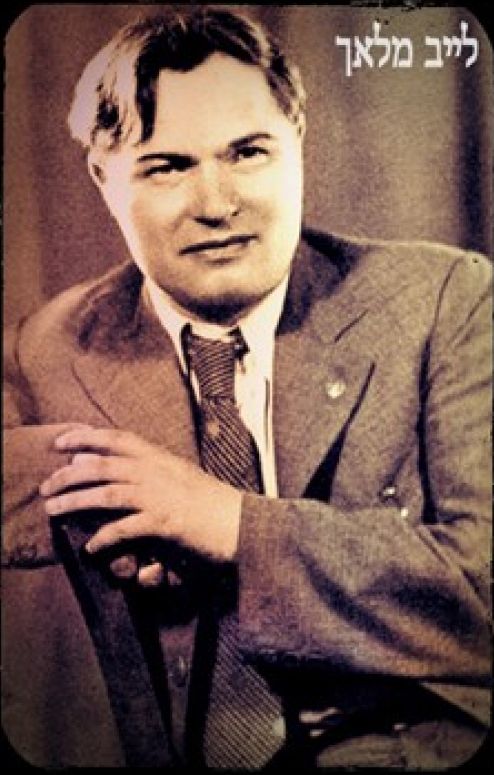
Leib Malach 27 November 1894 - 18 June 1936


I was surprised to find a tribute to Yiddish writer Leib Malach (originally Leib Salzman = Lejb Zalcman), posted on his birthday on Yiddishkeit's web site. It begins:
Leib Salzman (Lejb Zalcman), better known by his adopted name Leib Malach, was born November 27, 1894 in Zwoleń, Radom Gubernia. He moved as a teenager to Warsaw and worked at a variety of odd jobs there. Taken under the wing of the Yiddishist writer H.D. Nomberg, his writing began appearing in the Warsaw press.

He left Poland in 1922, settling and writing for the most part in Argentina, but traveled the world posting dispatches from his travels in the Yiddish press. He died suddenly after an operation in Paris on June 18, 1936.
None of Malach's works have ever been translated into English, except for one fragment of a notorious play. I learned of him via a 1939 Esperanto translation of his last play Mississippi (1936). I documented Misisipi on this blog and digitized a small part of the publication on my web site. But Yiddishkeit found this publication in the UCLA library and posted the image on the cover with its tribute and a caption:


"Malach's final and most performed play was Mississippi (cover of Esperanto translation shown here), which dealt with the 1931 Scottsboro trial. The play was written for Mikhl Weichert's Yung Teater in Warsaw, known for staging contemporary events like the trial of Sacco and Vanzetti."

And here is the original Yiddish play, in various formats: לייב מלאך

On the lower half of the tribute page is the following text, facing Phil Ochs' recording of his famous anti-racist song "Here's to the State of Mississippi":
In honor of Leib Malach’s most famous play, Mississippi, written in the immediate aftermath of the Scottsboro trial, listen to a song from Phil Ochs, written 30 years after the play’s Warsaw production. Here, Ochs brings the theme of justice denied in Mississippi up to 1965.
The slide show also features:
"Amol, Amol" (Once, Once)”: The cover of Malach’s epic poem "Amol, Amol," published in Warsaw, shortly before his emigration. Malach was a successful writer in a number of different genres.

From Spain to Holland: One of Malach’s many travel dispatches, this posthumously-published 1937 book describes Spain on the brink of civil war, fascist Germany, the leftist resistance in Vienna, and other travels throughout Western Europe.
Incidentally, the punchline to Phil Ochs' "Here's to the State of Misssippi" is "Mississippi find yourself another country to be part of."

2017-11-01

Zamenhof interview: Esperanto & Jewish Ideals

Now on my web site:

“Esperanto and Jewish Ideals,” Interview for the Jewish Chronicle with Dr. Zamenhof, The Jewish Chronicle, September 6, 1907, pp. 16-18. Note also the advertisement for "kakao" (cocoa).

With Zamenhof’s translation of ‘La Gaja Migranto’ (published in Fundamenta Krestomatio de la Lingvo Esperanto, 1903), mentioned in the interview.

This interview was translated into Esperanto and published in two parts. Note that R. I. [ = Isidore?] Harris is given as the interviewer:
Intervjuo kun d-ro Zamenhof de R. I. HARRIS, elangligis N. Z. MAIMON, La nica literatura revuo 6/3 (n-ro 33), Januaro-Februaro 1961, p. 82-89.
Intervjuo kun d-ro Zamenhof (fino) de R. I. HARRIS, elangligis N. Z. MAIMON, La nica literatura revuo 6/4 (n-ro 34), Marto-Aprilo 1961, p. 121-127.
Here I noticed interesting details about Zamenhof's thoughts on the Jewish question that I don't recall from other statements. For example, when he describes his attempt to create a new Judaism for the 20th century, he makes two curious assertions: (1) he almost blames his fellow Jews for isolating themselves within the nations in which they find themselves, but (2) he rejects Reform Judaism for excessive accommodation to the gentiles, who don't accept Jews anyway, Zamenhof thus abjures assimilationism as lacking self-respect. His project of Hilelismo (Hillelism, which later morphed into Homaranismo, no longer Jewish-specific and somewhat akin to Ethical Culture) was meant to reject an obsolete territorial (and superstitious) traditional conception of Judaism and modernize it to reflect the ethical ideal (of which monotheism is a part) incorporated in it.

Zamenhof's conception of the causes and cure of ethnic conflict betray an incredible lack of political sophistication. This can be seen most clearly in his paper “International Language” presented to the First Universal Races Congress in 1911. Denying economic causes for national conflict, Zamenhof curiously argues:
Can we say, for instance, that so many millions of poor Russians hate the millions of poor Chinese on economic grounds, when they shed their blood so willingly to defend their Russian oppressors against the attacks of foreigners? Assuredly not, for the Russian soldier knows very well, when he kills a Chinese soldier, that the man would never do him as much harm as the "mailed fist" of his own compatriots. It is not economic causes that give rise to national hatreds.
There is a glimpse of political consciousness in the reference to a group's own oppressors, which immediately disappears. His entire argument is abstract. While correctly denying intrinsic, ineluctable differences between peoples at the basis of animosity, Zamenhof exhibits not an ounce of political or historical consciousness in understanding how these problems came to be or what drives them. What he does show in his various statements is his intimate familiarity with Eastern Europe and the dilemma of Jews in this hostile environment.

This interview in English is invaluable, as the most extensive documentation of Zamenhof's engagement with the Jewish question, outside of his writings in Russian, is in Esperanto. But again, his political cluelessness comes to the forefront.

Zamenhof, soberly and with absolutely no self-aggrandizement, proposed the most far-reaching ambitious projects, all of which failed except for Esperanto, which succeeded in creating an international community of speakers that has survived 130 years, including the century following Zamenhof's death. Zamenhof projected into the future on a grand scale, from the vantage point of a provincial Eastern European Jew chafing at the ghettoization and discrimination that he suffered.

2017-07-03

Franz Kafka, datrevene

". . . Mi estas tiel soleca, kiel . . . kiel Franz Kafka." -- Franz Kafka

Franz Kafka naskiĝis la 3-an de julio 1883 en Prago. Ĉi-datrevene afiŝis Antonio De Salvo:

Franz Kafka – Esperanto-vivo

. . . pri la vivo kaj verkaro kaj tradukoj (en Esperanto) de Kafka. Oni interalie trovos ligojn al tradukoj, ekz. tiuj de Vilhelmo LUTERMAN:

Franco KAFKO (Franz Kafka): Rakontaro

Kaj ne forgesu la krokodilan retejon de esperantista poeto Mauro Nervi:

The Kafka Project by Mauro Nervi

2017-05-22

Bridge of Words (1)


I mentioned Bridge of Words: Esperanto and the Dream of a Universal Language by Esther Schor (Metropolitan Books, 2016) in a recent post, but I've been negligent in blogging about it. I am also acknowledged in it, as my web site is an invaluable source for research into Esperanto and its history.

April 14 marked the centennial of Zamenhof's death, which has been commemorated in various ways. (I have begun to blog about this, more to come.) In Zamenhof's lifetime, and for decades afterward, it was necessary to downplay Zamenhof's Jewishness due to the prevalence of Zamenhof, and in fact all of Zamenhof's children were murdered by the Nazis. Esperanto researchers and scholars, writing in Esperanto -- N.Z. Maimon and Adolf Holzhaus come to mind -- began to undo this enforced silence with documentation of Zamenhof's investment and activity in the Jewish world.  This dimension of Zamenhof's Jewish interests and their relation to Esperanto remained even more obscure in the English-speaking world than Esperanto generally. A few years ago Esther Schor began to write and speak about this in the USA. We lectured together at a symposium on Zamenhof on December 15 (his birthday), 2010, at a U.N. building. George Soros made a surprise visit, and while the rest of us got a photo op with him, only he was reported in the mainstream media. I was covered by the Jewish Daily Forward, though.

This book is the latest fruit of Esther Schor's endeavors. It has a strongly Jewish angle which is also bound to be emphasized in some reviews.


Michael Wex is a Yiddishist, known for such books as Born to Kvetch. It is not surprising that he would review this book in The New York Times (November 11, 2016) : "The Jewish Roots of Esperanto." Wex has some criticisms but overall appreciates the subject matter and whets the appetite, and of course highlights the Jewish dimension.


Stuart Schoffman's review "The Great Family Circle" in the Spring 2017 Jewish Review of Books is much narrower, but with some interesting anecdotes. Under the editorship Itamar Ben-Avi, the Jerusalem daily Do’ar Ha-yom published an item about Esperanto on January 23, 1924 and on several other occasions, its obsession with a Jewish renewal notwithstanding. On this date the writer noted that Zamenhof was a Jew, after reporting: "An anti-Semitic weekly in Germany had urged fellow anti-Semites to learn Esperanto, the better to communicate with anti-Semitic organizations in other countries." The short review also mentions Zamenhof's involvement in the proto-Zionist movement.

There is a contrasting pair of comments. The first is a poem from a snotty Zionist ridiculing Esperanto's universalism, Obama, and George Soros. The second is from an Esperantist posting Zamenhof's poem "La Espero" (Hope).


2017-05-10

A Seamstress Wants to Learn Esperanto


A Seamstress Wants to Learn Esperanto | YIVO Institute for Jewish Research | The Edward Blank YIVO Vilna Collections Project

May 1, 2017

The publication of Esther Schor's Bridge of Words: Esperanto and the Dream of a Universal Language occasioned this excavation from the YIVO archives.
This application for registration in an Esperanto course offered in the 1930s in Vilna (Wilno) by VILBIG (Vilna Jewish Education Society) was filled out by Tsile Lyubitsh, a young lingerie seamstress. Born in 1911, she was a member of the first generation to have attended one of the new secular Yiddish schools that were established in the wake of World War II.

What motivated Tsile to want to learn Esperanto? One possible clue comes from the memoir of a young Jewish man in Kielce, born in the same year at Tsile. A. Greyno, as he signed his submission to an autobiography contest sponsored by YIVO in the 1930s, was from a poor family. Like Tsile, he was a garment worker, and in his case, a trade unionist. He also dreamed of a world without borders, but more specifically, of a unified world proletariat, and had found a socialist Esperanto organization with which to affiliate [....]

Thank you, YIVO! See also the YIVO Encyclopedia of Jews in Eastern Europe:
Bialystok
Belmont, Leo
Braun, Mieczysław
Gorshman, Shira
Korczak, Janusz
Tuwim, Julian
Zamenhof, Ludwik
Zaretski, Ayzik

2017-04-23

Leendert Cornelis Deij: "Al la Juda Foririnto" / "To the Jew Who Walked Away"

This post commemorates the Holocaust Days of Remembrance in 2017. Holocaust Remembrance Day (Yom Hashoah) marks the anniversary of the Warsaw Ghetto Uprising.

Let us remember also that all of Zamenhof's children were murdered by the Nazis, and Esperanto was targeted as a Jewish conspiracy.

For decades this original Esperanto Holocaust-related poem has been my favorite on the theme of the Shoah. (I discovered some excellent Hungarian Holocaust poetry--some of which also has Esperanto translations--last year, but that is another story.) An English translation received a commendation in a British literary competition. I have reported on the poem, the poet, and the translation on this blog several times previously. I finally obtained the English translation, which I have added to the Esperanto original:

"Al la Juda Foririnto" / "To the Jew Who Walked Away"
by Leendert Cornelis Deij with English translation by Elizabeth Stanley

Note also William Auld's English translation:

Al la juda foririnto / To the Jewish Departed / Al judío que marchó
English translation by William Auld, literal Spanish translation by Fátima Maritela Marinera

Note that I have previously misspelled Deij's middle name, which should read ‘Cornelis’. ‘Leendert Cornelis Deij’ also appears under the names ‘Leen Deij’ and ‘Lodewijk Cornelis Deij’. When I figure out how to correct the subject heading, I will alter it to ‘Leendert Cornelis Deij’.

See also these web pages/sites:


2017-04-16

Boxer, Beetle (5)


The Boxer Beetle web site has disappeared, so here is the best I can give you, from the ghost web: Boxer, Beetle. I reproduce the images below:


2016-01-19

History of the Literary Cultures of East-Central Europe

Cornis-Pope, Marcel; Neubauer, John; eds. History of the Literary Cultures of East-Central Europe: Junctures and Disjunctures in the 19th and 20th Centuries. 4 volumes. Amsterdam; Philadelphia: J. Benjamins, 2004-2010.

Esperanto is mentioned in vols. 1-3. Vol. 4 mentions Sándor Szathmári.

Vol. 1 (2004): In the article "National operas in East-Central Europe" by John Neubauer (pp. 514 -523), there is a mention of an Esperanto translation (p. 515):

As a touching gesture of compensation, an enterprising Pole published in Paris an Esperanto translation of Włodzimierz Wolski’s libretto for Stanisław Moniuszko’s opera Halka.
Bibliographic reference (p. 620):
Wolski, Włodzimierz. Halka. Esperanto trans. Antoni Grabowski. Paris: Hachette, 1912.
Vol. 2 (2006): In the article "Ashkenaz or the Jewish Cultural Presence in East-Central Europe" by Seth L. Wolitz (pp. 314-331), on the Ashkenazi linguistic panorama (p. 328):
"It was not by accident that an Ashkenazic Jew, Ludwik Lazar Zamenhof, born in Bialystok and at first a Yiddishist, invented Esperanto (hope), a synthetic language designed to serve as an international expression of peace and thus to escape the nationalist baggage weighing any national tongue. Language was thus problematized by Jews around 1900, and the chosen medium indicated an ideological, political, and cultural commitment ranging from nationalist/religious/socialist confrontations around Hebrew and Yiddish, to an accommodationist use of the dominant language of the State, and further to the invention of a new tongue with an implied federalist agenda."
In another article: "Monuments and the Literary Culture of Riga" by Irina Novikova (pp. 40-56), on Russian poet Vsevolod Cheshikhin (pp. 44-45):
"His interest in creating a universal language similar to Esperanto reflected his faith in the internationalism of poetic culture."
From Wikipedia: Pan-Slavic language:
"Neposlava (Непослава) was created by Vsevolod Evgrafovich Cheshikhin (Всеволод Евграфович Чешихин) in 1915 in Nizhny Novgorod, Russia. In 1913 he created a system to construct zonal languages based on Esperanto affixes which are used with national roots and called it Nepo. Then in 1915 he created a nepo-language based on the Slavic lexicon - Neposlava ("Slavic Nepo"). He also used this system to construct other "new Esperantoes" based on Latin-Romance and Germanic languages."
Vol 3: The Making and Remaking of Literary Institutions (2007): From the "General Introduction" by John Neubauer (with Inna Peleva on Bulgaria and Mihály Szegedy-Maszák on Kölcsey and Széchenyi) (pp. 1-38), on competing Hebrew and Yiddish revivals (p. 13):
"The rivalry was unique even on a purely linguistic level, for unlike Croatian and Serbian or Czech and Slovak, Hebrew and Yiddish represented two radically different languages and cultures, both of which lived embedded in other linguistic environments (Russian, Polish etc.) that had reached already more advanced stages in their own awakening. Esperanto was invented by an Ashkenazi Jew, Ludwik Lazarus Zamenhof, as an attempt to overcome this Babel."
Vol. 4: Types and Stereotypes (2010): Introduction to section on women authors (pp. 221-227) in a discussion of dystopias mentions Sándor Szathmári (p. 226):
The most famous East-Central European dystopia R.U.R. (see Veronika Ambros's article in this volume), in which the robots kill off all but one of their makers on a remote island. Since they arenot programmed to generate successors, the robots also seem doomed to extinction, but a love affair between a male and a female robot offers some hope for species survival. The ending resembles that of Imre Madách's Az ember tragédiája (Tragedy of Man; 1862), where Adam, having surveyed the history and the projected future of mankind, wants to commit suicide and thus terminate mankind but is prevented from it by Eve's announcement that she is pregnant. Such pessimistic projections of a future surely qualify as dystopias, even if they do not involve totalitarian visions of society. Dystopic in this sense are also two Hungarian novels, Sándor Szathmári's Kazohinia (1941), one of the most important novels written in Esperanto, and Ferenc Karinthy's Epepe (1971), published in English with considerable success in 2008.

2015-10-29

Leendert (Lodewijk / Leen) Cornelius Deij (30 oktobro 1919 - 31 majo 2011)

Antaŭ jardekoj mi legis ĉi tiun memorindan poemon pri la Holokaŭsto:

"Al la Juda Foririnto" de Lodewijk Cornelius Deij

Mi supozis, ke Deij estis longe forpasinta, do mi surpriziĝis trovi lin ankoraŭ aktiva--mi ne memoras ĝuste kiel, eble per Literatura Foiro. Kompreneble, tio estis antaŭ multaj jaroj, kaj Deij fine mortis en 2011.

Mi jen mencias lian blogon:

La muelejo de Leen Deij

Vi povas legi plu kaj trovi pluajn verkojn ĉe antaŭaj afiŝoj. Mi nepre devis afiŝi nun okaze de la datreveno de la naskiĝo de ĉi tiu elstara esperantisto.

2015-01-30

Ralph Dumain deklamas "Spinozo"n de Jorge Luis Borges

Dankon al Paulo Silas. Li konvertis mian sondosieron al video kun muziko. Mi deklamas la poemon "Spinozo"n de Jorge Luis Borges en angla kaj Esperanta tradukoj.


La tekstoj troveblas ĉe . . .

“Spinoza” poem by Jorge Luis Borges, translated by Richard Howard & César Rennert

“Spinozo” de Jorge Luis Borges, tradukis Julius Balbin


2014-06-19

Postcards from Bialystok


“Postcards from Bialystok” – my third comic book by Joanna Karpowicz is a product of collaboration with The Ludwig Zamenhof Center in Bialystok, Poland. The format is that of the graphic novel. There is some beautiful work here as the outcome of soaking up the history and atmosphere of Bialystok. Naturally, our dear Ludwig and his fellow Jews play a major role.

2014-05-08

Deklamo: "Spinoza" de Jorge Luis Borges en angla & Esperanta tradukoj

Jen freŝa sondosiero (kun tekstoj) de poemo "Spinoza" de Jorge Luis Borges deklamita de Ralph Dumain en angla & Esperanta tradukoj.

New sound file of R. Dumain reciting poem "Spinoza" by Jorge Luis Borges in English & Esperanto translations, with texts:

“Spinoza” by Jorge Luis Borges translated by Richard Howard & César Rennert, with Esperanto translation by Julius Balbin, recited by / deklamis / Ralph Dumain (sound file / sonregistraĵo). See web pages:

  • “Spinoza” poem by Jorge Luis Borges, translated by Richard Howard & César Rennert
  • “Spinozo” de Jorge Luis Borges, tradukis Julius Balbin
Mi deklamis ĉi tiun paron (sen sonregistro) kiam mi prelegis pri Borges ĉe la Zamenhof-bankedo de Esperanto-Societo de Vaŝingtono en decembro 2013.


2014-03-11

Jewish utopian nostalgia & Esperanto in fiction: 2 reviews

This seems to be a trend in Jewish novels for a number of years now. Looking backward, reflecting on dashed hopes and lost possibilities, ideals failed or betrayed: Jewish fiction is casting Esperanto in a utopian role.  Here are my two latest reviews:

2013-12-22

65a datreveno por senradikaj kosmopolitoj!

Antaŭ kelkaj monatoj mi ekpensis pri starigo de Tago de Senradikaj Kosmopolitoj. “Senradikaj kosmopolitoj“ estis stalinista kodvorto por judoj (plejparte intelektuloj), markante fatalan turnpunkton en la antisemitisma konduto de Sovetunio dum preskaŭ ties tuta historio. Sovetunio jam estis kaptita de la paranojo de Stalin en la “Purigoj“ de la 1930aj jaroj, sed la paranojo akcelis kaj kun ĝi akcelis ksenofobio, naciismo, bigoteco, kaj persekutemo post la venko super la nazioj, kvazaŭ imitante ties praktikon de persekutado kaj la detruado de kulturo (en Sovetunio sub Ĵdanov).

Hipernaciisma, kontraŭ-okcidenta kampanjo kontraŭ “malpatriotaj“ “kosmopolitaj“ tendencoj komencis oficiale en 1946 (la 14an de aŭgusto, en Pravda). Ĝin ligis specife kun judoj ĉi tiu parolado:

A. Fadeev: "O nekotorykh prichinakh otstavanie sovetskoi dramaturgii" [Pri Pluraj Kaŭzoj de la Evolumanko de Sovetia Dramarto], Literaturnaya gazeta (Moskvo), 22 decembro 1948, p. 1.

La situacio de tiam degeneris al murdoza kampanjo kontraŭ sovetiaj judoj, kiun ĉesis nur la morto de Stalin.

Se tiu kampanjo estus homo, ĝi hodiaŭ emeritiĝus en Usono. Sed ĝia signifo ne limiĝas je la pasinteco. Orienta Eŭropo, regresinta al sia antaŭsovetia modo, estas fekujo de bigoteco kontraŭ judoj kaj aliaj grupoj.  Sed eĉ en Usono, kiu plurfacete progresis dum la pasinta duonjarcento, restas problemo. Sistema diskriminacio aktuale viktimigas “ne-blankulajn“ grupojn, dum la “blankul-etnanoj“ kiuj antaŭe suferis diskriminacion estas plejparte asimilitaj en la blankula “ĉefvojo“. Sed sennombraj usonanoj, enfermataj en rigidaj rasaj/religiaj kategorioj (eĉ eks-kristanaj ateistoj), eĉ tiuj kiuj ne malamikas, ne kapablas kompreni judojn, aparte la sekularajn, aparte tiujn kiuj ne situas en fiksa kategorio. Do jen danĝera potencialo stimuli la paranojeman menson al kiu la judeco estus mutaciema, fremda, suspektema, serpenta ento. Kaj kiam la socipolitiko de lando degeneras, kiel okazas ankaŭ en Usono, oni devas esti singarda.

Kompreneble, Zamenhof estis iu el tiuj senradikaj kosmopolitoj, kaj esperantistoj judaj kaj nejudaj estis traktataj simile en malfavoraj situacioj.

Do, senradikaj kosmopolitoj, hodiaŭ staru fiere, kaj la nekomprenuloj bugru sin!

Mia alternativa dato por Tago de Senradikaj Kosmopolitoj estas la 27a de julio. Tiun tagon en 1656 la benata Baruch Spinoza estis eksigita de la juda komunumo, iĝonta en la homa historio la unua senradika kosmopolito, teorie kaj praktike.

2013-10-02

Hitler's surprising obsession

Actually, it's not surprising at all to those who have known for decades about Hitler's targeting of the Esperanto movement for persecution as a Jewish conspiracy, and the Nazis' murder of all three of Zamenhof's children. But here's another reminder, with links:

Hitler's surprising obsession

One of the links given is to this blog. Note also:

Speech at the US Holocaust Memorial Museum about Esperanto

I participated in this event, sharing my knowledge with the Holocaust Museum in Washington.

Review of the book La Danĝera Lingvo

This is Don Harlow's review, in English, of "The Dangerous Language," the most thorough documentation of fascist and Stalinist persecution of the Esperanto movement.

New to me though is the reference to Valdemar Langlet, a Swedish Esperantist who saved many Jews from the Nazis.

Charlie Chaplin used Esperanto as the language of the Jewish ghetto in his landmark 1940 film The Great Dictator. I have known about this for decades but never attempted to research what motivated Chaplin. The blogger links this to Nazi persecution of Esperantists. Chaplin could have known about the Nazis' opposition to Esperanto and Esperanto's internationalism which Chaplin would have endorsed.

The blogger does not explain the poster reproduced on his post, and above. It is one of the anti-fascist posters in Esperanto produced during the Spanish Civil War.

2013-09-23

Amos Oz: Esperanto among the Kibbutzim

Famous Israeli author Amos Oz, who lived on a kibbutz for decades, has written a book of connected stories about kibbutzim, Between Friends. The publication release date for the English translation is September 24.  One of the stories in the book is titled "Esperanto." Here are excerpts from two reviews.

Amos Oz explores the daily lives behind utopian dreams in 'Between Friends' by Michael Walsh, Daily News, September 18, 2013
 The collection concludes with a masterfully rendered story called “Esperanto,” which has an atmosphere so rich it can almost be considered a character itself. It focuses on Martin Vandenburg, an anarchist who teaches Esperanto, the easy-to-learn constructed language that was crafted to transcend nationality and promote peace.
Between Friends by Amos Oz – review by Alberto Manguel, The Guardian, Wednesday 8 May 2013
The Esperanto teacher declares that "imprecise words poison relations between people everywhere, and that's why clear, accurate words can heal those relationships, but only if they are the right words spoken in a language that all people can understand". One of the students observes that Cain and Abel "probably spoke the same language too"; another says nothing but thinks that "the sorrow in the world was born long before words".

Vandenberg believes humans are essentially generous and kind-hearted but corrupted by their environments. He wants states to be abolished and replaced with an international, pacifist brotherhood of Esperanto speakers.

“When all human beings speak the same language,” he tells his class, “there will be no more wars because their common language will prevent misunderstanding among individuals and peoples.”

This claim reveals an ideological rift. Students question his belief with instances of violence between people who spoke the same language: Cain and Abel, German Jews and Nazis.

One student sat quietly, thinking “the sorrow in the world was born long before words.”

If that young man is correct, then the feeling of sadness, miscommunication and pain existed long before anyone uttered those nouns, which are essentially metaphors for something intangible.
On this web page are two videos and links to the story "Esperanto" in Italian and Hebrew:

Video. Amos Oz, Esperanto (Festival Internazionale delle Letterature 2012 – Basilica di Massenzio, Roma )

In the second of these videos, Oz recites the story in Hebrew, accompanied by music and Italian subtitles.  The first is an interview in which Oz summarizes the story "Esperanto," which you can view right here:

2013-09-22

Carl Alpert remembers Lidia Zamenhof

 Thanks to Neil Blonstein for publicizing this article and attendant information:

 “Interesting People I Have Met: Lidia Zamenhof” by Carl Alpert

From this little piece alone one can see the idealism and naivete of Lidia. She thought she could solve social problems by propagating Esperanto and the Baha'i religion throughout the world. In a way, her thinking was a step backward from her father's, which itself did not sufficiently engage the world politically. Lidia's innocence extended to her sojourn in the USA, which was far more extensive than her father's, but it had a curious twist: Lidia innocently crossed racial boundaries in the USA in a way that others would not have. There are many black Bahai's in the USA—I've known many of them myself—and Lidia cultivated a number of them in the 1930s.